Showing posts with label Suzuki. Show all posts

Suzuki GSX-R750 SRAD, The Last 750 Superbike !

It is 30 years since the first Suzuki GSXR750F burst onto the scene, bringing with it an intoxicating mix of endurance race styling, proven technology and light weight. The 750F was launched in the same year of great machines such as the Yamaha FZ750, the Honda NS400R, the Kawasaki GPZ600R and Suzuki’s own king of the strokers the RG500. And yet the GSX-R750 continued to be developed. Today it’s hard to imagine a Suzuki range without at least one GSX-R in it and various capacity GSX-Rs have been produced (spotters rightly say it’s 31 years since the GSX-R400 came out in 1984...).


Suzuki GSX-R750 SRAD Review, The Last 750 Superbike !


With the 750 being such a long-lived model, it was only natural that there would be times when it was outclassed – as it was in the early to mid-1990s. The competition was white-hot – the popularity of production racing in the form of World Superbikes had ensured that machines such as Kawasaki’s ZXR750 H-M models were selling like hot cakes, while homologation specials from Ducati with its 851/888 and Honda with the VFR750R RC30 and Yamaha with its OW-01 were the machines at the sharp end.

But where was Suzuki? Well it was nowhere, on track by the early 1990s. The early successes of the slabside machine in superstock racing soon gave way to middling results in superbike classes (save for Kevin Schwantz’s performances in AMA) for various reasons. Suzuki swapping from a long-stroke motor to the short-stroke 750J in 1988 – and then back again with the RR-K homologation special of 1989 – didn’t help. And the machine’s up-and-over double cradle frame may have been a signature of its design, but it made the engine stand tall in the frame, making breathing through a big airbox difficult and it fell into turns compared to the opposition.

The bike was also oil/air-cooled at a time when water-cooled bikes showed the way forward. Despite this, it took the prodigious talents of our own James Whitham to win a Production 750 title on a Slingshot in 1988 and an MCN TT-F1 title on the elderly F1-based machine he used in 1991.

The introduction of the water-cooled GSXR750WN in 1992 did little to stem the decline in racing – even if on the road GSX-Rs always sold well. What Suzuki wanted was a machine that had the DNA of the GSX-Rs of old, but with the modern engine and chassis architecture of a mid-1990s superbike.


Suzuki GSX-R750 SRAD Review, The Last 750 Superbike !


On April 8, 1993, Suzuki bosses met at their headquarters in Hamamatsu and made the decision to build a world-beating, high-performance motorcycle that would also give them the base from which to launch an attack on the World Superbike series. The existing double-cradle 750WP was not really setting the world on fire, thanks to new 750 models such as Yamaha's YZF and Honda's CBR900RR FireBlade. Suzuki knew it needed to start with a fresh sheet of paper, unshackled by design traits from the past, such as the double-cradle frame. It also wanted to stick to the 750cc capacity class and take the fight to the Blade on the road (despite losing 167cc to it) so it could also be eligible for production racing.

Thankfully for Suzuki it had the new RGV500, campaigned that year by Kevin Schwantz, upon which to base the new GSX-R. Schwantz normally suffered compared to his rivals by having a 500cc two-stroke race machine which was fickle, but even by April 1993 Suzuki could see that the new RGV was different. Later that year Kevin would take the title and the dimensions of his bike would be used as a starting point for the GSX-R750WT.

Haruo Terado was group leader for Suzuki’s motorcycle engineering department and he was at that first meeting. He recalls:

"In 1993 others had released new 750cc sports machines so this made it necessary to create a new generation of GSX-R with all the heritage that name had. We decided to do this we would use Kevin’s RGV500 Gamma two-stroke 500 and combine it with a light-weight but powerful four-stroke 750cc powerplant. Our engineers were given a target weight of 179 kilos and a power-to-weight ratio of 1.398 kilos per horsepower."

Suzuki GSX-R750 SRAD Review, The Last 750 Superbike !


In charge of the engine development was Masahiro Nishiwaka and the basic engine architecture was set at 72 x 46mm bore and stroke (identical to the YZF and the RC30), with a redline set around 13,500 RPM for the short-stroke motor. Weight-saving meant that the whole engine was nine kilos lighter than the previous model’s and the engine was narrower too, thanks to the use of SCEM (Suzuki Composite Electro-chemical Material) which negated the use of cylinder liners, meaning the bores were 5mm closer together than previously. Giving the bike the name by which the model was known ‘SRAD’ was the ‘Suzuki Ram-Air Direct’, the firm’s own version of ‘Ram-air’ which Kawasaki had used to great effect on machines such as the ZZ-R into the airbox and then onto the 39mm Mikunis. With around 5% extra power at speed thanks to the SRAD system, power was a remarkable 126bhp at 12,000 RPM – comparing well with the Blade.

Chassis-wise, engineers used the baseline geometry and wheelbase of the RGV and clearly had to go with an aluminium beam-frame. Actual data shows that at 1400mm, the SRAD was actually shorter than that of the RGV500 by 20mm. It was also 5mm shorter than the FireBlade, 10mm shorter than the Ducati 916 and 20mm shorter than the Kawasaki ZX-7R and Yamaha YZF750. The beam frame was made from stamped aluminium sheet, with die-cast aluminium alloy sections that carried the steering head and swingarm pivot shaft. The whole frame was made using the same construction techniques as the RGV. 43mm upside-down forks were at the front, with a single shock on an upperbraced alloy swingarm.

If anything made people stand and stare at the GSX-R750WT SRAD it was the aerodynamic clothes it wore. The wasp-like rear-end was a love/ hate design trait, but the front the twin-shrouded headlights still had a GSX-R-esque scowl.The first glimpse the press got of the new GSX-R was when an amateur photographer standing trackside at Laguna Seca in California spotted the SRAD in shakedown tests in the summer of 1995. AMA Yoshimura Suzuki riders Fred Merkel and Thomas Stevens were seen thrashing both road and race versions of the new machine.

The world launch took place at Misano, Italy – back in the day when it was raced the ‘proper’ way around. The accolades came almost instantly. Most testers agreed it was a harsh, free-revving monster with nothing resembling good manners. But it was a GSX-R after all. Group tests in early 1996 saw it either close to the Blade in overall performance or better than the Honda. Cycle World in the USA made it the winner of their ‘Ultimate Sportbike Challenge’ against the likes of the Blade and the Ducati 916. They even called it "the closest thing to a street-legal grand prix bike."


Suzuki GSX-R750 SRAD Review, The Last 750 Superbike !


Riding A street legal grand prix bike… Hyperbole, surely ? Thankfully if it does all go wrong, it’s my bike, so I don’t need to go crawling back to the owner. Chucking a leg over a pretty standard and mint GSX-R750WT SRAD is a pretty hard thing to do. Nowt to do with the seat height (at 830mm it’s the highest of its peers and you will often catch that pillion hump) but more because GSX-Rs are rarely standard.

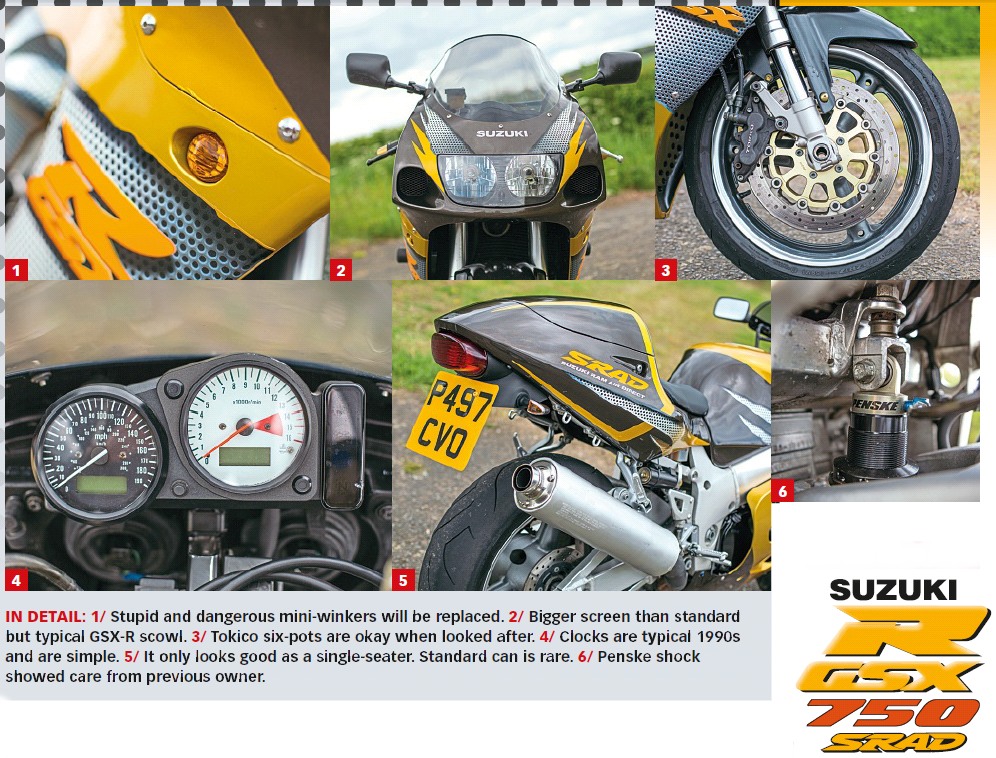
I found this one locally on eBay. It was pretty standard (apart from the dangerously naff mini/submerged indicators) and all with just around 18k on the clocks. Sitting aboard the SRAD and I recall back in the day the original screen would almost cut the tops of the clocks, so it almost egged you into a racing crouch. This has a slightly blown screen, so you can see the clocks: clutch in, (a Suzuki trait) time to fire her up. Jab the button and add a dash of choke from the left-thumb lever and you’re welcomed by a harsh mechanical cacophony.The noise is almost the four-stroke version of a team of huskies raring to get going. This thing tells you at even at tickover that it’s ravenous for roads.

A downward click on the high-set gear lever and it’s time to go for it. Pottering around is not what the GSX-R750WT does. You feel that when you ride slowly on an SRAD. Where a comparable Blade or ZX-7R will have a dollop of civility and torque, the Suzuki – even at idle – feels like it needs to be unleashed. Give it some on an open road series. Two huge scoops fed air through the frame and the bike comes alive. Which is handy, as the comfort isn’t the best. Those handlebars are vibey, the clutch heavy on this example and the pegs feel slightly high. There’s also a slight rise to the gear lever which is even making me – with size 11 boots on – have to almost lift my foot a tad off the peg to go up a gear. Some fiddling needed then, but there’s no need to fiddle with my smile which gets wider as the rev-counter rises.


Suzuki GSX-R750 SRAD Review, The Last 750 Superbike !


Sure, this thing will have less torque than a Blade, but this doesn’t mean it’s unrideable, just a little more demanding low-down. At 3000 RPM it will waddle along okay enough if you’re paying attention, but then as the tacho spins past 8000 RPM this thing starts to really take off, then when you get past 10,000 you’re really motoring, it’s still bloody amazing for a 20-year-old machine. Little wonder that in many road tests of the time the SRAD would be pumping out MORE power than the CBR900RR.

Words come straight to mind: two-stroke and hooligan. These have oft been used to describe the motor and they are still relevant today. Chassis-wise we’re let down a little here, thanks to being shod with Avon’s old sports tyre offering the VP2 and the brakes aren’t as good as I remember. Firstly, the tyres are just well past their best, so new ones would improve things a little. With the bike being so short anyway, I will probably go for a good, sports-touring tyre, as today’s offerings have more grip than the outright sports tyres of yester-year. That said this thing still steers like the original did, but there’s just some little vagueness in the steering that I can’t quite put my finger on. Either way it’s only a mild annoyance and you can sense a good 80% of the original bike in there. It still feels light – even if a bit bulbous in some areas – and scuttles through sweeping bends with minimal effort.

On the brake side I was a bit puzzled, as the bike came with a £450 bill for a full service AND new brake seals. The brakes were powerful, but you’d give them a good ol’ tug and it would take a little time to get the bite you expected. Despite both of these issues the bike still felt good and you know that with a little TLC it could be as good as it was brand-new. Yup, there’s still a lot of fun to be had on the GSX-R SRAD – mainly when you’re at 10,000 RPM or more.

These things are (to coin the popular phrase) bullet proof. Which is good as most will have been thrashed, trashed and loaded with more tat and pointless frippery than you could shake a stick at. Hooligans are attracted to GSX-Rs in a way that they aren’t to CBRs so expect to find rough ones.


Suzuki GSX-R750 SRAD Review, The Last 750 Superbike !


Let’s go front to back, shall we? Wheels, tyres and brakes: the one let-down on our test machine is the polished rims – they will be going back to standard, although many are polished as the original paint was very soft. Tyres: the first model came in 120/70 and 190/50 17s and you’ll find much debate with owners as to whether to go down to a 180/55 or even a 190/55. The 750Y of 2000 had a longer swingarm and 1.410 mm wheelbase, but went to a 180/55 to speed up steering a bit as a result, but people also fit them on the SRAD. It’s as much personal preference and look and what you use the bike for. We would suggest sticking to what’s recommended and in that size you’ve everything to choose from, from sports-touring to hypersport tyres.

When it comes to the SRAD’s brakes, for some reason the mid-to-late 1990s six-pot Tokicos always come in for a lot of stick – unfairly in our view. On many models the six-pots are swapped for bolt-on Nissin four-pots, but this is a maligned caliper and people trash them without sorting it. It seems the recesses where the pistons sit are not anodised but machined aluminium. Oxide forms around the dust seals, which increases pressure on the seals until they seize. They need regular cleaning and also SBS pads are a good swap from OE or the favoured EBC as they give a firmer ‘feel’ on the lever. The test bike had recently had a seal kit (£77.45) and new EBC pads (at £57.02) so I too may be going SBS...


Suzuki GSX-R750 SRAD Review, The Last 750 Superbike !


Engine-wise you’re on a winner with the SRAD, as there aren’t many issues with this very solid engine. The thing thrives on revs and the only reported issues other than due to ham-fisted home servicing and the like are issues with keeping on top of the cam-chain tensioner and regulator/rectifiers letting go – pretty much similar to most 1990s Jap machines. Many will have aftermarket filters and exhaust on, as well as some carb work.

So if yours is running rough, you either need to invest in some set-up and dyno time, or go back to standard everything – which works just fine thank you. Later, fuel-injected models can have the FI light operate thanks to throttle-valve cap cables snagging: often this issue will have come and gone by now though.

Suspension was of a pretty high standard for the day, but thanks to the nature of the beast (sporty) and the nature of our roads (pot-holed) this (and tyres) should be the first thing you upgrade. Our example has a Penske rear shock in situ and many owners will upgrade (sometimes with the shock from later/other GSX-R models) but the original was just fine – albeit some owners reported that some bolts around the frame/shock area seem to mysteriously come loose. But then the SRAD is a vibey, visceral creature.

As touched upon before, the finish of the bike wasn’t the best of the Japanese – so expect soft paint on the wheels and the odd peeling sticker: as well as boot scuffs around that seat hump. Price-wise things are firming up – and quite rightly. The original was a shade under £9000 new, and good, clean bikes with around 30-40k on the clocks are still at around the £2k mark, but things are only going to go one way. We’ve seen low-milers around 10k on the clocks for around £3000. You will find lots of hounds out there and many racetrack/trackday refugees. All you really want to throw at a good, clean SRAD are tyres, chains/sprockets and keep on top of those brake seals.


Conclusion


Suzuki GSX-R750 SRAD Review, The Last 750 Superbike !


It’s just this simple: the Suzuki GSX-R750 SRAD is a bona fide classic, like the GS1000, GSX1100 EFE and GSX-R750F before it: it represents something very special for Suzuki. A yardstick in Suzuki performance, it is a big leap forward for the GSX-R range and the Japanese sports motorcycle as a whole. The best bit is that most people don’t seem to know it yet.

In a couple of months, the Suzuki GSX-R750 SRAD will be two whole decades old, and yet (despite the VJMC’s 15 year rule) people still seem to dismiss these modern milestones as bikes not worth saving, buying, or tucking away for the future. Meanwhile for those of us of a certain age, we remember the first time we savoured that SRAD power and the feeling is just as intoxicating the second time round. Do yourself a favour and try one.


Suzuki GSX-R750 SRAD Specs


Engine : Four stroke, Inline-Four, DOHC 16-Valve, Liquid-Cooled
Bore x Stroke : 72 x 46 mm
Capacity : 749 cc
Compression Ratio : 11.8 : 1
Induction : 4 x Mikuni BDSR 39mm Carbs
Max Power : 126 HP @ 12.000 RPM
Max Torque : 80.5 N.m @ 10.000 RPM
Transmission / Drive : 6-Speed / Chain

Frame : Alumunium Twin-Beam Frame
Front Suspension : 43 mm Upside Down Forks, Fully Adjustable
Rear Suspension : Rising-Rate Monoshock, Fully Adjustable
Front Brakes : 2 x 320 mm Disc, 6-Pot Calipers
Rear Brakes : Single 220 mm Disc, 2-Pot Caliper
Front Tyre : 120/70 - ZR17
Rear Tyre : 190/50 - ZR17

Wheelbase : 1.400 mm
Seat Height : 830 mm
Weight : 179 Kg (dry)
Fuel Capacity : 18 Litres


Price : £1700 - £2500 (Minter)

2016 Suzuki RF1000R Concept !

Our "New Concept Reborn" piece on the unloved Suzuki RF900 stirred one of our crew soul: he had one back in the day and thinks we should reboot it for modern times. Suzuki’s 1994 RF900 was an astonishing machine. It boasted enough performance to be labelled a GSX-R in its own right. It did 165mph, had a great front end (particularly the 1995 RS2 update with fully-adjustable forks), and was bargain-priced in comparison with the GSX-Rs of the day. The looks divided opinion, especially the rear tail-light which consisted of a single bulb running light with two bulbs underneath for braking. 


2016 Suzuki RF1000R Concept


The Ferrari-esque fairing slats never made another appearance in the Suzuki range (besides the smaller RF600 and 400) which is a shame, we think. So we think it’s only fair to resurrect the RF; using an SRAD/K5 hybrid frame, GSX-R1000 K5 engine and some Busa-inspired bodywork we give you our vision of the RF for the 21st century. Come on Suzuki... you know it makes sense. Well, a little bit, anyway.


Chassis


Good enough in 1995 for licence-shredding speed, good enough today. Our GSX-R750 SRAD/K5 frame is light, strong and in plentiful supply. Suspension-wise the latest GSX-R1000 Big piston forks and shock have all the adjustment you’d expect or need, as do the rearsets. Brembo brakes provide stopping power and lightweight Marchesinis are an upgrade over the heavy three-spokers on the original.


Engines


The Engine is stock 160bhp GSX-R1000K5, and that’s enough. Also chosen for use in the 2015 GSX-S1000s, there’s low and midrange grunt aplenty but stacks more eyeball-popping horsepower, plus an extra gear compared to the original five-speed RF900. The exhaust has taken the evolutionary next step and is out of sight in the belly-pan, aiding aerodynamics and mass-centralisation.


Bodywork


With a modified Busa fairing and RF900-style vents in the sides, this baby is built for speed, whether it’s the fast-as-you-like German autobahn or just looking fast parked on your drive. Sleek, unique, and light on its feet. Colour schemes echo modern and retro – especially the RF900 S2 purple, which we think just rocks a retro 90s look!

2015 Suzuki GSX-S1000F Review, Fast but Friendly !

First thoughts of the Suzuki GSX-S1000F are dominated more by what it doesn’t have than what it actually does. Maybe it’s something that’s highlighted by the presence of the other bikes, but as eyes dart back and forth between them the mental checklist grows longer. The GSX-SF doesn’t have an adjustable screen. No fittings for hard luggage. No pillion grabrails, no mainstand, nor anything to make setting the suspension quick and easy.


"Of course not," explain Suzuki, though I may be paraphrasing. "The GSX-S1000F is a sportsbike, for sportsbike riders, so we didn’t bother with any of that sensible stuff." I’m not convinced – just leaving stuff out doesn’t automatically make what’s left over any better. Not putting baked beans on a Full English doesn’t make the sausages any sausagier.

Yet after riding BMW R1200RS and also Kawasaki Z1000SX, I’ll have to eat my preconceptions. The GSX-S1000F really is the sportiest bike here. It’s the lightest (by a healthy margin) and the most powerful (by a whisker). Pegs are highest, steering feels fastest. Enjoying an ice cream and the splendour of Bamburgh Castle, I ask fellow tester Simon which of the bikes he thinks would be quickest around Cadwell Park. After a moment of chin-stroking (his own, not mine), his mouth reaches the same conclusion as my brain: "The Suzuki."

The Suzuki GSX-S1000F achieves this not through any specific elements of unique genius, but a general nose-to-tail refinement. But then maybe it should. The motor is, after all, based on the GSX-R from a decade ago. The swingarm and switchgear are both borrowed from other bikes already in Suzuki’s range. And when a band starts putting together a compilation album, you’d hope they’ll pick their most successful material.


Carving south-west across Northumberland on the B6341 from Alnwick to Otterburn, this brand-new machine feels utterly, intuitively recognisable. The familiar four pulls with a superbike’s long-legged drive. Gearing is quite tall, and the 999cc capacity hasn’t been plumped up with any extra bottom-end shove. Instead of devouring and disposing of gears, the Suzuki GSX-S1000F holds each one and treasures it. Revs build deliberately, bringing big speed: first gear pulls to 85mph; second puts the digital speedo into triple figures.

While the power delivery is typical sportsbike, the riding position is anything but. The Suzuki GSX-S1000F's Renthal Fatbar one-piece handlebar is exactly the same as that on the GSX-S1000 roadster, providing an identical upright riding position. It’s unconventional for a fully faired bike but actually quite welcome on backroads, letting you throw the bike around with ease.

Suspension has been tweaked a little from the naked GSX-S, with ever-so-slightly more damping. Forks are fully adjustable and the rear shock offers preload and rebound, but I’ve no desire to touch those dials. It’s remarkably good as it comes: composed yet compassionate. It doesn’t wallow or buck about, does a fine job of disguising lumps and bumps, and offers enough support to let you hammer the four-piston front brakes or wind on plenty of power.

And if you want any extra encouragement to do so, like the naked GSX-S1000 this GSX-S1000F has a traction control system. You can choose from three heights of safety net or turn it off altogether – and, if you do, it stays turned off the next time you start the bike. Unlike the naked, ABS is standard fitment rather than an option in Suzuki GSX-S1000F.


Where you’d hope the Suzuki GSX-S1000F offers some tangible benefit over its unfaired sibling, however, things are less impressive. It might have a fairing – far from attractive, though it’s definitely there – but the protection it offers feels negligible. The screen is tiny and far too low, and while it doesn’t cause any buffeting you do quickly start to resent it being there if it’s not actually doing anything. It’s likely a compromise of the riding position – the screen can’t be too prominent, else you couldn’t turn the handlebars to full lock.

Maybe GSX-S owners won’t care about the screen size. Nor the pillion seat, nor the fuel tank, which are the smallest here. Because if none of that matters and you just want to distil the discussion down to pure riding terms, the Suzuki GSX-S1000F is a worthy winner: more dynamic than the BMW R1200RS, and more composed than the Z1000SX.


2015 Suzuki GSX-S1000F Specs


Engine : Four stroke, Inline Four, DOHC 16-Valve, Liquid-Cooled
Capacity : 999 cc
Bore x Stroke : 73,4 x 59 mm
Compression Ratio : 12,2 : 1
Induction : Fuel Injection
Max Power : 143 HP @ 10.000 RPM
Max Torque : 105 N.m @ 9.500 RPM
Transmission / Drive : 6-Speed / Chain

Frame : Alumunium Twinspar
Front Suspension : 43mm Upside Down Forks, Fully Adjustable
Rear Suspension : Monoshock, Adjustable Preload and Rebound
Front Brakes : 2 x 310 mm Disc, 4-Pot Calipers, ABS
Rear Brakes : Single 250 mm Disc, 1-Pot Caliper, ABS
Front Tyre : 120/70 - ZR17
Rear Tyre : 190/50 - ZR17

Wheelbase : 1.460 mm
Seat Height : 810 mm
Weight : 215 Kg
Fuel Capacity : 17 Litres


Price : £10,135

Typical Finance (base model bikes) : Suzuki Finance PCP: £2329 Deposit, 34 Months £132.39, Final cost £4802 – total £11,764.65

Suzuki TL1000S, A Bad Boy Bike !

The original aim was to buy a bad boy of a bike, the most deranged machine to ever escape the captivity of Japan at the time – a Suzuki TL1000S. I loved the concept of the TL-Series, the looks I was in awe of, the half fairing showing off the motor and the bike signing things off with that platypus of a tail unit. Ultimately, I could just picture myself astride this bike pulling massive wheelies away from the lights and leaving big dark lines at the exit of every corner.


Suzuki TL1000S


And that’s why I bought a Yamaha YZF R6. Ultimately, I’m a head over heart person, and I found a dealer who was offering a spanking new R6 cheap, but since then, I’ve always hankered after a Suzuki TL1000S. That’s why I was interested to see an absolute minter parked outside JHS Racing. My brain can’t quite work out why someone bought this new and then proceeded to do just 2500 miles over the course of the next 10 years, but at least I had the keys for the day – this was going to be good.

Suzuki TL1000S Stock cans were a bit of a turn-off as the whimper from the 996cc V-Twin Motor was somewhat of a surprise. I was expecting shake, rattle and roll to be generated from those big pistons thrusting up and down, but in return for applying some choke and thumbing the starter, I got a timid tickover. With 105bhp at the rear wheel, in pure power terms, time hasn’t been kind to the Suzuki TL1000S (well, perhaps if you’re used to new bikes like me) but 100bhp is ample for the highways.


Suzuki TL1000S


So how does the Suzuki TL1000S look today? Well, the muted dark blue didn’t float my boat in the way the original red one did with its gaudy graphics, but the riding position felt eminently usable. Though the fixtures and fittings looked like relics from a bygone era to me, the riding position built by swept bars and high clip-ons feels relevant for cornering action.

It’s different to be on something truly mechanical these days, where your inputs have direct results when applied to the recipient component. My head felt clearer knowing that I was in control of my own destiny, rather than electronics masking any miscreant use (again, it’s what we modern bike riders are used to). Though injected, the drive off the throttle from the motor is clean and punchy in the right zone – anywhere from 4000rpm up. It doesn’t possess a heavyweight’s wallop, but engage the right ratio at the right time and it delivers a hearty thump.

The noise gets better with speed too, with the airbox’s inhalation and motor’s explosions doing their best to mask what little the pipes exhale. But I’m still to see how this engine could have caused the problems that are so associated with the Suzuki TL1000S. It didn’t feel so outrageous that the chassis couldn’t cope. So that meant it was time to coax it. I remember reading so much about the bike’s geometry, weight, power and ultimately its radical rotary damper rear suspension that caused the inherent instability on road. Suzuki TL1000S eases its way through the roads I’m on, and to be honest they’re not the challenge of some, but the bike does what a bike does – it brakes, turns and fires out again. I’m in jeans and a jacket, but I could easily get a knee-down if I was properly attired.


Suzuki TL1000S


Time has been relatively kind to the Suzuki TL1000S here. Okay, so the brakes don’t bite hard on the first squeeze and the tyres need plenty of time to warm up before they hark back to their youth and start gripping, but the action of cornering itself is sweet. It tips in well; not super quick, but quickly enough. It struggles a bit to hustle it through a roundabout, as much an indication of weight and its centre of gravity, but it delivers precisely what it set out to achieve – to be an A and B-road bahn-stormer.

And there’s so much potential here. If you get in at the ground floor with something a bit shabby you can spend what you saved in honing the Suzuki TL1000S to something near perfection – new cans lop weight and add power, refreshed suspension delivers more poise and added precision, new lines and pads return the bite to the brakes. There really is life in almost any old dog, but this one is a bit too pristine. I want a shabby old sleeper that looks rough but goes well.


My rose-tinted visor thought the Suzuki TL1000S would be a belter, offering manful power and requiring manful control. But it’s a bit of a pussycat, all told. It got a reputation as it couldn’t deliver much else to be honest – and suckers like me dined out on this controversy. I’m not saying it didn’t have issues, because it did, but the biggest issue it had was the people on top trying to force it to be a GSX-R750. Had I bought one back in 1999, I’m pretty sure I’d still own it. Characterful bikes from Japan don’t come round very often, and the Suzuki TL1000S is surely the most characterful of the lot, certainly more so than my first R6...


Suzuki TL1000S Specs


Engine : Four stroke, 90º V-Twin, DOHC 8-Valve, Liquid-Cooled
Capacity : 996 cc
Bore x Stroke : 98 x 66 mm
Compression Ratio : 11.3 : 1
Induction : 2x 52 mm Mikuni Denso EFI
Max Power : 125 HP @ 8.500 RPM
Max Torque : 103 N.m @ 8.000 RPM
Transmission / Drive : 6-Speed / Chain

Frame : Aluminium Trellis
Front Suspension : 43mm Inverted Forks, Fully Adjustable
Rear Suspension : Rotary Damping System, Fully Adjustable
Front Brakes : 2 x 320 mm Disc, 4-Pot Calipers
Rear Brakes : Single 220 mm Disc, 2-Pot Caliper
Front Tyre : 120/70 - ZR17
Rear Tyre : 180/60 - ZR17

Wheel base : 1.415 mm
Seat Height : 835 mm
Wet Weight : 191 Kg
Fuel Capacity : 17 Litres

Suzuki GSX1100E, Superb Classic Four !

Suzuki really stirred up the pot with the GSX1100E of 1980, if you wanted sphincter-searing acceleration at a knock down price the GSX had it all covered.


Suzuki GSX1100E


Suzuki sat back to watch the combined efforts from Honda, Yamaha and Kawasaki flounder in its wake until (with the opposition closing the gap) the EFE was born in 1984, and it had no intention of taking any prisoners.

The GSX1100E motor is astoundingly simple : it has Inline four cylinders, five speeds and one destination, the top of the heap. It builds on the principles established as far back as the GT750 water-cooled two-stroke. The transmission layout is very similar, this design carried on to the GS750, the GS1000 and then the GSX1100.


The crank and gearbox input and output shaft centres are shared with its four-stroke buddies, the basic design of the camshaft drive chain and tensioners is a simple evolution of its forebears. That’s the trick that Suzuki pulled off for the umpteenth time, no crazy ideas, just good old simplicity and brilliance of design that don’t hanker after adulation or adoration, but that does tend to follow after the first time you crank open the throttle on one!

Around the time that the 100 horsepower gate swung open the Big 4 were all capable of producing bikes that could transcend this hurdle but there were many problems which befell them. There were chocolate cams and recalcitrant camchain tensioners and second gear selectors that did and then didn’t.

Big problems emerged when bikes exceeded 200 kilos and 100 HP. But the EFE tore up that risk assessment, and then proceeded to tear up the quarter mile with Pee Wee Gleason on board in mid 10 second order at close to 130mph. These numbers were pretty impressive back then... wait a mo, they’re pretty impressive now ! The reason for this massive rush of ballbusting torque is simple, the development that Suzuki did on the GSX1100 was just the starter, when the main course rolled up the EFE had a totally sorted carb/cam/valve/piston/exhaust combo.


Suzuki GSX1100E


The carbs were just big enough to allow in excess of 110 HP but small enough to encourage high intake velocity which gave near perfect atomisation of the intake charge, hence great midrange and throttle response regardless of gear position or the position of the tacho needle.

The cams, likewise didn’t need crazy lifts or excessive spring pressures to get the job done, just enough was okay thanks. The intake valves increased in diameter by 1mm from 27 to 28mm but the exhaust stayed the same at 23mm. The 76mm pistons are lovely, tough with slim rings, the forgings (not castings) are neatly ribbed under the crown for strength and heat dissipation.

Yet again Suzuki pulled a rabbit out of their hat here, generally speaking, alloys used for casting use a higher proportion of silicone in their mix. This reduces the coefficient of expansion thus allowing tighter piston to wall clearances, the ART alloy used for the forged pistons still allows minimal clearances which were previously unheard of. It might be worth mentioning here that Suzuki’s GS1000R F1 racebikes used pistons crafted by Fred Hadleigh at Omega in the West Midlands.

What is truly amazing is the similarity twixt the Omega design and the later factory pistons as installed in the EFE, and yes I am aware that the 1000R was a two-valver and the GSX has four of ’em, the design clues I’m referring to relate to the internal design as opposed to the piston crown.

Vincenzo Piatti pioneered a fully machinable combustion chamber which optimised compression, valve size and flame travel to burn the precious charge in the most efficient way possible. With this single refinement the GSX and its first cousin, the EFE, stomped off into the distance, any gear, any revs, anytime.

Given the fact that there was so much of everything available at relatively low engine speeds, riding an EFE was rapidly recognised as a good way to spend a Sunday afternoon, they start easily, will run on just about any kind of fuel without complaining, they don’t get hot, they have a huge alternator to fire up the similarly huge headlamp and they don’t wilt after a tankful of abuse. Even 30 odd years after its release the EFE has a loyal band of followers that can’t get enough of that torque-nami, sure they dress ’em up with USD forks and trick swingarms (like Colin Peabody’s lovely bike here) but the stuff that sits under that crackle black cam cover is sacrosanct, the beating heart of a true classic.


The architecture that was laid down back then has not changed, particularly in drag racing circles (or should that be straights?) Whatever, EFE-based bikes, with a few tweaks are running over three seconds quicker down the 1320 than Pee Wee ran at Orange County International Raceway all those years ago, sure they have multi-stage lock up clutches and trick auto boxes and digital everything but underneath are still the rock solid design concepts that haven’t been improved on. With capacities of up to 1600cc by virtue of big pistons and stroker cranks it’s unlikely there will ever be a more appropriate basis for this kind of lunacy as slimmer, modern engines afford less room to grow.

So we have a great spread of everything, reliability, simplicity, strength and power. Can’t last can it? And it didn’t, fuel injection, water cooling and Nikasil plated bores changed what had previously been simple and pure into, well, complicated, and we don’t really do complicated. So the EFE continues to co-exist with its younger siblings, I wonder how things will be in another 30 years? I know which one my money’s on.


Suzuki GSX1100E Specifications


Manufacturing : Suzuki Motor Co.

Model : GSX1100E (EFE)

Production Year : 1972 - 1976


Engine : 4-Stroke, Oil-Cooled, Inline 4 Cylinder DOHC 16-Valve

Bore x Stroke : 72 x 66 mm

Cylinder capacity : 1.074 cc

Fuel Supply System : Carburetor Mikuni 34mm

Compression ratio : 9.5: 1

Transmission : 5 - Speed

Ignition : CDI

Starter : Electric Starter

Max Power : 100 HP @ 8.700 RPM

Max Torque : 85,3 N.m @ 6.500 RPM

Top Speed : 227 Km / h


Dimensions L x W x H : 2.255 x 760 x 1.190 mm

Wheelbase: 1.510 mm

Ground Clearance: 152 mm

Dry weight : 237 kg

Fuel tank capacity: 19 L


Frame : Tubular Steel Double Cradle

Front Suspension : 37mm Kayaba Telescopic Fork

Rear Suspension : Kayaba Dual Shock

Front Brakes : Dual Hydraulic Disc 275mm, 2 Pots

Rear Brakes : Single Hydraulic Disc 275mm, 2 Pots

Front Tires : 3:50 - 19

Rear tires : 4.50 - 17

2010 Suzuki GSX-R1000

2010 Suzuki GSX-R10002010 Suzuki GSX-R1000
motorcycle modification Proudly Powered by Blogger