Showing posts with label Motorcycle History. Show all posts

Suzuki GSX-R750 SRAD, The Last 750 Superbike !

It is 30 years since the first Suzuki GSXR750F burst onto the scene, bringing with it an intoxicating mix of endurance race styling, proven technology and light weight. The 750F was launched in the same year of great machines such as the Yamaha FZ750, the Honda NS400R, the Kawasaki GPZ600R and Suzuki’s own king of the strokers the RG500. And yet the GSX-R750 continued to be developed. Today it’s hard to imagine a Suzuki range without at least one GSX-R in it and various capacity GSX-Rs have been produced (spotters rightly say it’s 31 years since the GSX-R400 came out in 1984...).


Suzuki GSX-R750 SRAD Review, The Last 750 Superbike !


With the 750 being such a long-lived model, it was only natural that there would be times when it was outclassed – as it was in the early to mid-1990s. The competition was white-hot – the popularity of production racing in the form of World Superbikes had ensured that machines such as Kawasaki’s ZXR750 H-M models were selling like hot cakes, while homologation specials from Ducati with its 851/888 and Honda with the VFR750R RC30 and Yamaha with its OW-01 were the machines at the sharp end.

But where was Suzuki? Well it was nowhere, on track by the early 1990s. The early successes of the slabside machine in superstock racing soon gave way to middling results in superbike classes (save for Kevin Schwantz’s performances in AMA) for various reasons. Suzuki swapping from a long-stroke motor to the short-stroke 750J in 1988 – and then back again with the RR-K homologation special of 1989 – didn’t help. And the machine’s up-and-over double cradle frame may have been a signature of its design, but it made the engine stand tall in the frame, making breathing through a big airbox difficult and it fell into turns compared to the opposition.

The bike was also oil/air-cooled at a time when water-cooled bikes showed the way forward. Despite this, it took the prodigious talents of our own James Whitham to win a Production 750 title on a Slingshot in 1988 and an MCN TT-F1 title on the elderly F1-based machine he used in 1991.

The introduction of the water-cooled GSXR750WN in 1992 did little to stem the decline in racing – even if on the road GSX-Rs always sold well. What Suzuki wanted was a machine that had the DNA of the GSX-Rs of old, but with the modern engine and chassis architecture of a mid-1990s superbike.


Suzuki GSX-R750 SRAD Review, The Last 750 Superbike !


On April 8, 1993, Suzuki bosses met at their headquarters in Hamamatsu and made the decision to build a world-beating, high-performance motorcycle that would also give them the base from which to launch an attack on the World Superbike series. The existing double-cradle 750WP was not really setting the world on fire, thanks to new 750 models such as Yamaha's YZF and Honda's CBR900RR FireBlade. Suzuki knew it needed to start with a fresh sheet of paper, unshackled by design traits from the past, such as the double-cradle frame. It also wanted to stick to the 750cc capacity class and take the fight to the Blade on the road (despite losing 167cc to it) so it could also be eligible for production racing.

Thankfully for Suzuki it had the new RGV500, campaigned that year by Kevin Schwantz, upon which to base the new GSX-R. Schwantz normally suffered compared to his rivals by having a 500cc two-stroke race machine which was fickle, but even by April 1993 Suzuki could see that the new RGV was different. Later that year Kevin would take the title and the dimensions of his bike would be used as a starting point for the GSX-R750WT.

Haruo Terado was group leader for Suzuki’s motorcycle engineering department and he was at that first meeting. He recalls:

"In 1993 others had released new 750cc sports machines so this made it necessary to create a new generation of GSX-R with all the heritage that name had. We decided to do this we would use Kevin’s RGV500 Gamma two-stroke 500 and combine it with a light-weight but powerful four-stroke 750cc powerplant. Our engineers were given a target weight of 179 kilos and a power-to-weight ratio of 1.398 kilos per horsepower."

Suzuki GSX-R750 SRAD Review, The Last 750 Superbike !


In charge of the engine development was Masahiro Nishiwaka and the basic engine architecture was set at 72 x 46mm bore and stroke (identical to the YZF and the RC30), with a redline set around 13,500 RPM for the short-stroke motor. Weight-saving meant that the whole engine was nine kilos lighter than the previous model’s and the engine was narrower too, thanks to the use of SCEM (Suzuki Composite Electro-chemical Material) which negated the use of cylinder liners, meaning the bores were 5mm closer together than previously. Giving the bike the name by which the model was known ‘SRAD’ was the ‘Suzuki Ram-Air Direct’, the firm’s own version of ‘Ram-air’ which Kawasaki had used to great effect on machines such as the ZZ-R into the airbox and then onto the 39mm Mikunis. With around 5% extra power at speed thanks to the SRAD system, power was a remarkable 126bhp at 12,000 RPM – comparing well with the Blade.

Chassis-wise, engineers used the baseline geometry and wheelbase of the RGV and clearly had to go with an aluminium beam-frame. Actual data shows that at 1400mm, the SRAD was actually shorter than that of the RGV500 by 20mm. It was also 5mm shorter than the FireBlade, 10mm shorter than the Ducati 916 and 20mm shorter than the Kawasaki ZX-7R and Yamaha YZF750. The beam frame was made from stamped aluminium sheet, with die-cast aluminium alloy sections that carried the steering head and swingarm pivot shaft. The whole frame was made using the same construction techniques as the RGV. 43mm upside-down forks were at the front, with a single shock on an upperbraced alloy swingarm.

If anything made people stand and stare at the GSX-R750WT SRAD it was the aerodynamic clothes it wore. The wasp-like rear-end was a love/ hate design trait, but the front the twin-shrouded headlights still had a GSX-R-esque scowl.The first glimpse the press got of the new GSX-R was when an amateur photographer standing trackside at Laguna Seca in California spotted the SRAD in shakedown tests in the summer of 1995. AMA Yoshimura Suzuki riders Fred Merkel and Thomas Stevens were seen thrashing both road and race versions of the new machine.

The world launch took place at Misano, Italy – back in the day when it was raced the ‘proper’ way around. The accolades came almost instantly. Most testers agreed it was a harsh, free-revving monster with nothing resembling good manners. But it was a GSX-R after all. Group tests in early 1996 saw it either close to the Blade in overall performance or better than the Honda. Cycle World in the USA made it the winner of their ‘Ultimate Sportbike Challenge’ against the likes of the Blade and the Ducati 916. They even called it "the closest thing to a street-legal grand prix bike."


Suzuki GSX-R750 SRAD Review, The Last 750 Superbike !


Riding A street legal grand prix bike… Hyperbole, surely ? Thankfully if it does all go wrong, it’s my bike, so I don’t need to go crawling back to the owner. Chucking a leg over a pretty standard and mint GSX-R750WT SRAD is a pretty hard thing to do. Nowt to do with the seat height (at 830mm it’s the highest of its peers and you will often catch that pillion hump) but more because GSX-Rs are rarely standard.

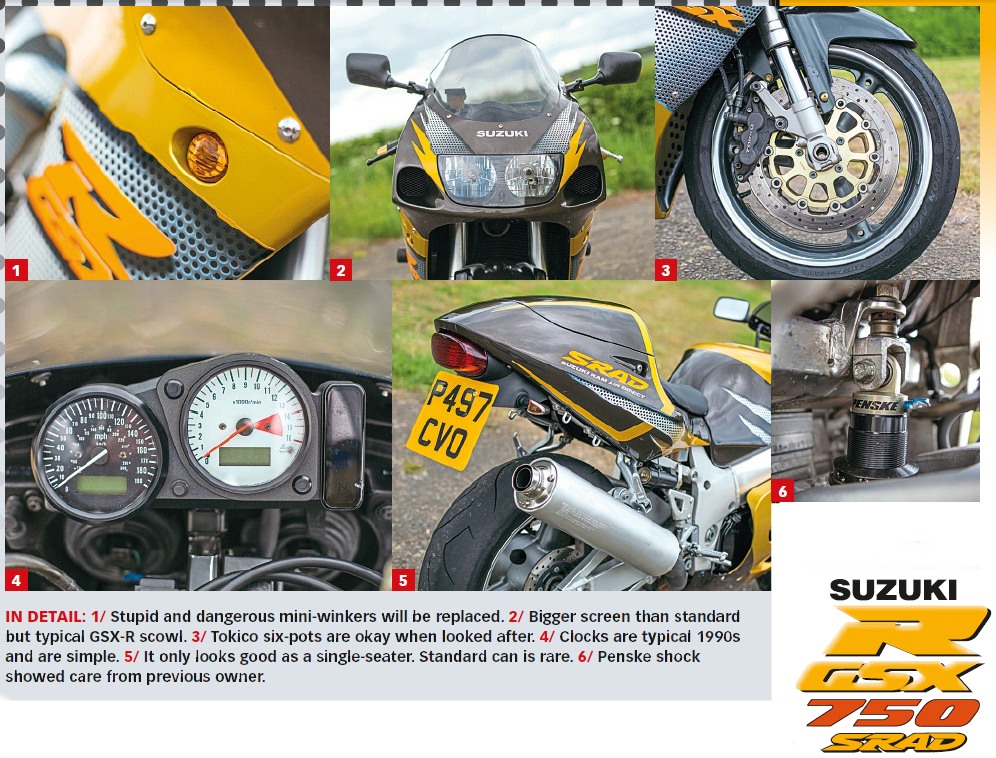
I found this one locally on eBay. It was pretty standard (apart from the dangerously naff mini/submerged indicators) and all with just around 18k on the clocks. Sitting aboard the SRAD and I recall back in the day the original screen would almost cut the tops of the clocks, so it almost egged you into a racing crouch. This has a slightly blown screen, so you can see the clocks: clutch in, (a Suzuki trait) time to fire her up. Jab the button and add a dash of choke from the left-thumb lever and you’re welcomed by a harsh mechanical cacophony.The noise is almost the four-stroke version of a team of huskies raring to get going. This thing tells you at even at tickover that it’s ravenous for roads.

A downward click on the high-set gear lever and it’s time to go for it. Pottering around is not what the GSX-R750WT does. You feel that when you ride slowly on an SRAD. Where a comparable Blade or ZX-7R will have a dollop of civility and torque, the Suzuki – even at idle – feels like it needs to be unleashed. Give it some on an open road series. Two huge scoops fed air through the frame and the bike comes alive. Which is handy, as the comfort isn’t the best. Those handlebars are vibey, the clutch heavy on this example and the pegs feel slightly high. There’s also a slight rise to the gear lever which is even making me – with size 11 boots on – have to almost lift my foot a tad off the peg to go up a gear. Some fiddling needed then, but there’s no need to fiddle with my smile which gets wider as the rev-counter rises.


Suzuki GSX-R750 SRAD Review, The Last 750 Superbike !


Sure, this thing will have less torque than a Blade, but this doesn’t mean it’s unrideable, just a little more demanding low-down. At 3000 RPM it will waddle along okay enough if you’re paying attention, but then as the tacho spins past 8000 RPM this thing starts to really take off, then when you get past 10,000 you’re really motoring, it’s still bloody amazing for a 20-year-old machine. Little wonder that in many road tests of the time the SRAD would be pumping out MORE power than the CBR900RR.

Words come straight to mind: two-stroke and hooligan. These have oft been used to describe the motor and they are still relevant today. Chassis-wise we’re let down a little here, thanks to being shod with Avon’s old sports tyre offering the VP2 and the brakes aren’t as good as I remember. Firstly, the tyres are just well past their best, so new ones would improve things a little. With the bike being so short anyway, I will probably go for a good, sports-touring tyre, as today’s offerings have more grip than the outright sports tyres of yester-year. That said this thing still steers like the original did, but there’s just some little vagueness in the steering that I can’t quite put my finger on. Either way it’s only a mild annoyance and you can sense a good 80% of the original bike in there. It still feels light – even if a bit bulbous in some areas – and scuttles through sweeping bends with minimal effort.

On the brake side I was a bit puzzled, as the bike came with a £450 bill for a full service AND new brake seals. The brakes were powerful, but you’d give them a good ol’ tug and it would take a little time to get the bite you expected. Despite both of these issues the bike still felt good and you know that with a little TLC it could be as good as it was brand-new. Yup, there’s still a lot of fun to be had on the GSX-R SRAD – mainly when you’re at 10,000 RPM or more.

These things are (to coin the popular phrase) bullet proof. Which is good as most will have been thrashed, trashed and loaded with more tat and pointless frippery than you could shake a stick at. Hooligans are attracted to GSX-Rs in a way that they aren’t to CBRs so expect to find rough ones.


Suzuki GSX-R750 SRAD Review, The Last 750 Superbike !


Let’s go front to back, shall we? Wheels, tyres and brakes: the one let-down on our test machine is the polished rims – they will be going back to standard, although many are polished as the original paint was very soft. Tyres: the first model came in 120/70 and 190/50 17s and you’ll find much debate with owners as to whether to go down to a 180/55 or even a 190/55. The 750Y of 2000 had a longer swingarm and 1.410 mm wheelbase, but went to a 180/55 to speed up steering a bit as a result, but people also fit them on the SRAD. It’s as much personal preference and look and what you use the bike for. We would suggest sticking to what’s recommended and in that size you’ve everything to choose from, from sports-touring to hypersport tyres.

When it comes to the SRAD’s brakes, for some reason the mid-to-late 1990s six-pot Tokicos always come in for a lot of stick – unfairly in our view. On many models the six-pots are swapped for bolt-on Nissin four-pots, but this is a maligned caliper and people trash them without sorting it. It seems the recesses where the pistons sit are not anodised but machined aluminium. Oxide forms around the dust seals, which increases pressure on the seals until they seize. They need regular cleaning and also SBS pads are a good swap from OE or the favoured EBC as they give a firmer ‘feel’ on the lever. The test bike had recently had a seal kit (£77.45) and new EBC pads (at £57.02) so I too may be going SBS...


Suzuki GSX-R750 SRAD Review, The Last 750 Superbike !


Engine-wise you’re on a winner with the SRAD, as there aren’t many issues with this very solid engine. The thing thrives on revs and the only reported issues other than due to ham-fisted home servicing and the like are issues with keeping on top of the cam-chain tensioner and regulator/rectifiers letting go – pretty much similar to most 1990s Jap machines. Many will have aftermarket filters and exhaust on, as well as some carb work.

So if yours is running rough, you either need to invest in some set-up and dyno time, or go back to standard everything – which works just fine thank you. Later, fuel-injected models can have the FI light operate thanks to throttle-valve cap cables snagging: often this issue will have come and gone by now though.

Suspension was of a pretty high standard for the day, but thanks to the nature of the beast (sporty) and the nature of our roads (pot-holed) this (and tyres) should be the first thing you upgrade. Our example has a Penske rear shock in situ and many owners will upgrade (sometimes with the shock from later/other GSX-R models) but the original was just fine – albeit some owners reported that some bolts around the frame/shock area seem to mysteriously come loose. But then the SRAD is a vibey, visceral creature.

As touched upon before, the finish of the bike wasn’t the best of the Japanese – so expect soft paint on the wheels and the odd peeling sticker: as well as boot scuffs around that seat hump. Price-wise things are firming up – and quite rightly. The original was a shade under £9000 new, and good, clean bikes with around 30-40k on the clocks are still at around the £2k mark, but things are only going to go one way. We’ve seen low-milers around 10k on the clocks for around £3000. You will find lots of hounds out there and many racetrack/trackday refugees. All you really want to throw at a good, clean SRAD are tyres, chains/sprockets and keep on top of those brake seals.


Conclusion


Suzuki GSX-R750 SRAD Review, The Last 750 Superbike !


It’s just this simple: the Suzuki GSX-R750 SRAD is a bona fide classic, like the GS1000, GSX1100 EFE and GSX-R750F before it: it represents something very special for Suzuki. A yardstick in Suzuki performance, it is a big leap forward for the GSX-R range and the Japanese sports motorcycle as a whole. The best bit is that most people don’t seem to know it yet.

In a couple of months, the Suzuki GSX-R750 SRAD will be two whole decades old, and yet (despite the VJMC’s 15 year rule) people still seem to dismiss these modern milestones as bikes not worth saving, buying, or tucking away for the future. Meanwhile for those of us of a certain age, we remember the first time we savoured that SRAD power and the feeling is just as intoxicating the second time round. Do yourself a favour and try one.


Suzuki GSX-R750 SRAD Specs


Engine : Four stroke, Inline-Four, DOHC 16-Valve, Liquid-Cooled
Bore x Stroke : 72 x 46 mm
Capacity : 749 cc
Compression Ratio : 11.8 : 1
Induction : 4 x Mikuni BDSR 39mm Carbs
Max Power : 126 HP @ 12.000 RPM
Max Torque : 80.5 N.m @ 10.000 RPM
Transmission / Drive : 6-Speed / Chain

Frame : Alumunium Twin-Beam Frame
Front Suspension : 43 mm Upside Down Forks, Fully Adjustable
Rear Suspension : Rising-Rate Monoshock, Fully Adjustable
Front Brakes : 2 x 320 mm Disc, 6-Pot Calipers
Rear Brakes : Single 220 mm Disc, 2-Pot Caliper
Front Tyre : 120/70 - ZR17
Rear Tyre : 190/50 - ZR17

Wheelbase : 1.400 mm
Seat Height : 830 mm
Weight : 179 Kg (dry)
Fuel Capacity : 18 Litres


Price : £1700 - £2500 (Minter)

1974 Ducati GT750, Incredible Machine !

I really shouldn’t have been surprised at just how good this Ducati GT750 was. After all, as a teenager in the 1970s I’d admired and lusted after those big Bolognese V-twins; read about them and dreamed about them, while riding around on a succession of much cheaper and less glamorous Japanese and British machines.


Since then I’ve been lucky enough to ride numerous classic Ducatis, and not one has been a disappointment. But the brilliance of the GT750 – the first of the Ducati V-twin line – still came as a surprise. Simply looking around this immaculate bevel-drive twin was a treat; admiring its stylish orange-and-black paintwork, its period badges, and the lines of that big air-cooled engine with its cooling fins going off in all directions and its attractive, rounded alloy crankcases. Sitting astride the firmly padded seat and firing up the motor with a lazy kick to send the slender Conti pipes barking out their uniquely tuneful sound...

But after finally riding away on what, after all, was the first and least powerful of the twins, I was stunned to discover that it was not just respectably rapid but torquey, stable, bursting with character and most of all wonderfully enjoyable to ride. Perhaps my sense of surprise at how good the Ducati GT750 was came because such is the reputation of more famous models such as the 750 Sport, 750SS, 900SS and others that followed it, I’d subconsciously assumed that the basic 748cc V-twin that began the line was relatively ordinary. It was overshadowed by the more glamorous sports models, and presumably had some teething problems or at least some minor design flaws that made it less than desirable all these years later?


But nothing could be further from the truth. On the contrary, the Ducati GT750 with which Ducati’s design genius Fabio Taglioni introduced the V-twin line was not just a bold and innovative high-performance machine when introduced in 1971, it was also remarkably capable and well-sorted right from the word go. Apart from paint colour and a few relatively minor mods there was no difference between this late-model GT, which was built in 1974, and the first machines off the Bologna production line in 1971.


Winning Performance


Fabio Taglioni


For a relatively small and financially struggling company such as Ducati to get things so right in the early 1970s was an impressive achievement. And a hugely significant one, too. It could be argued that, of all the hundreds of models that Ducati has produced since the marque began bike production in the mid-1940s, the model that started the V-twin line is the most important of all. As well as launching Ducati’s superbike range in such style, and leading to so many other great roadsters, the Ducati GT750 was also the basis of vital racing success, most notably with Paul Smart’s famous Imola 200 victory in 1972.

Ducati GT750 was very much the work of Taglioni, who had joined Ducati from Mondial in 1954 in the all-powerful post of chief designer and technical director, at the age of just 34. As an engineering student at Bologna university six years earlier he had produced a design for a 250cc, 90º V4 with cylinders running in line of the bike. At Ducati in the early 1960s, after revitalising the company with successful singles including the legendary 100cc Gran Sport, he adapted this V4 layout to create the mighty Apollo, which never reached production largely because its 1260cc engine was too powerful for contemporary tyres to handle.

Ducati had long been aiming to produce a twin, but not with cylinders in a Vee. The firm had raced parallel twins in the 1950s, and in the mid-1960s developed a succession of larger engined parallel twins, with the aim of creating a roadster to compete with dominant British models. But although a 500cc twin was displayed at the Daytona Show in the US in March 1965, neither that bike nor the 700cc prototype that followed two years later reached production. Meanwhile Honda launched the CB450 twin, whose arrival helped ensure that an improved 500cc Ducati parallel twin was met with little enthusiasm by the Italian firm’s dealers in the vital US market. The project was abandoned.


By this time Ducati was in financial trouble, and in 1969 the firm was taken over by the Italian government. Honda had recently introduced the CB750 Four, and fortunately Ducati’s new management team not only saw the need for a 750cc model, but also realised that it needed to be something special rather than another parallel twin. Taglioni, whose stated design aim was "simplicity, carried out to its ultimate extreme", adapted his earlier V4 layout to create a V-twin, or more accurately an L-twin, that was essentially two 350cc singles on a common crankcase.

Ducati worked fast. Taglioni’s design was finished by March 1970, the first engine was being tested four months later, and it was so impressive and trouble-free that by September a complete bike was ready to be unveiled to the press. By June 1971 it was in production: called the Ducati GT750 (also often referred to as the 750GT), and incorporating a few changes from that prototype, including flat bars instead of clip-ons, a 280mm Lockheed single front brake disc instead of a Fontana drum, 30 mm Amal Concentric carbs instead of Dell’Ortos, and a reshaped tank and seat unit.


As well as being distinctive, the engine layout had obvious advantages of small frontal area and low centre of gravity. The 90º Vee angle gave perfect primary balance, while Taglioni’s decision to raise the front cylinder by 15º from horizontal allowed good cooling to both pots while also helping exhaust routing and ground clearance. The effect of the L-motor’s inevitable length was minimised by the way the front cylinder head fitted between the downtubes of the tubular steel frame.

Like the factory’s well-proven singles, the V-Twin Engine featured bevel drive to a single overhead camshaft, wetsump layout, and an integral five-speed gearbox. The 748cc motor had conventional coil valve springs instead of the Desmo layout that Taglioni had already introduced on some racing singles, and produced a claimed 60 HP at 8000 RPM. At 185kg dry the Ducati GT750 was 15kg heavier than the prototype, but considerably lighter than the 67 HP Honda CB750 four. That gave the GT750 a very impressive power-to-weight ratio back in 1971.

With its rider’s chin on the tank the Ducati GT750 was good for a genuine 125mph that made it one of the world’s fastest bikes in the early 1970s. And its handling, especially at high speed, was notably better than that of heavier Japanese multis such as the CB750, Suzuki’s GT750 and Kawasaki’s H1 500 air-cooled triples. Right from this model – its first superbike–Ducati hit on the format of relatively light-weight, minimalist but rigid frame and fairly firm suspension that would make the marque’s name a byword for handling excellence.


With just a single disc up front, the Ducati GT750's braking ability didn’t live up to its cornering performance. The other fork leg had lugs for a second disc but Ducati never fitted one, though the factory did introduce a few updates on later versions, including this bike’s centre-axle front forks (instead of the original leading-axle design), and the addition of an electric starter on the last bikes to leave the factory. There was also a GT750 USA model, with higher bars, and a police version with screen, pannier and single seat.

Production ended in late 1974, when the Ducati GT750 was replaced by the 860 GT, with its controversial angular styling. By this time the 750 had been hotted up to create the more aggressive 750 Sport, with its clip-ons, rearsets and optional half-fairing; and the even racier 750 Super Sport, with its Desmo valve operation and single seat, that was inspired by that famous Imola victory.

Ducati’s V-twin range was well under way, and one of the great motorcycling dynasties had been established. More than four decades later those sportier models and bigger 864cc Desmos get the lion’s share of the publicity, but the Ducati GT750 that began the V-twin line in such brilliant style is far from forgotten...


Ducati GT750 Specs


Engine : Four Stroke, 90º L-Twin, SOHC 4-Valve, Air-Cooled
Capacity : 748 cc
Bore x Stroke : 80 x 74.4 mm
Compression Ratio : 8.5 : 1
Induction : 2x 30mm Dell'Orto
Max Power : 60 HP @ 8.000 RPM
Transmission / Drive : 5-Speed / Chain

Frame : Steel Tubular
Front Suspension : 38mm Ceriani Telescopic Forks
Rear Suspension : Twin Marzocchi Shock Absorber, Adjustable Preload
Front Brakes : Single 280 mm Disc, 2-Pot Calipers
Rear Brakes : 203 mm Drum Brake
Front Tyre : 3.60 - 19 Pirelli Phantom
Rear Tyre : 4.10 - 18 Pirelli Phantom

Wheelbase : 1.500 mm
Seat Height : 790 mm
Wet Weight : 185 Kg
Fuel Capacity : 17 Litres

1998 Yamaha FZS600 Fazer, Superb Fazer !

Some bikes – just a few – manage to be just that bit more than just the sum of their parts. Yamaha’s Superb FZS600 Fazer is just that. The Fazer’s motor is courtesy of the YZF Thundercat, derived from the mid-1990s FZR600R but with fins and things plonked onto it to make you think it’s air-cooled – it isn’t. What it is, is one of the best carbureted bikes I’ve ever ridden, just as it was almost 20 years ago. Power was class-leading for the time (80-90bhp), but the mid-range was what made this a winner compared to its peers.


1998 Yamaha FZS600 Fazer, Superb Fazer


Moving from the Thundercat’s 36mm Keihins to 38mm Mikunis gave the Yamaha FZS600 Fazer a good beefy strip of torque, but for some reason if you’re used to more powerful motors, the FZS600 Fazer’s delivery just seemed a tad hesitant: there’s that almost elastic-band feeling on the throttle that you have to get used to. Nowt hesitant about the brakes, mind: if you want to reverse back into yesterday, simply brush the lever with a finger or two and you have instant stopping power – that’s courtesy of the YZF-R1’s blue-spot calipers. If you could level any criticism on the Fazer it’s here – is it a tad over-braked for newcomers?


Handling-wise the Yamaha FZS600 Fazer is just so assuredly spot-on – even by today’s standards. Okay, so some people at the time moaned about the 110/70-17 front hoop, but, like a 16in Blade or Hornet frontend, it is fine. You just may have issues getting tyres. Handling is helped by those lovely wide bars. It steers so nicely, not sportsbike quick, or cruiser slow – like Baby Bear’s porridge, it’s ‘just right’. Now, me and the Yamaha Fazer 600 go way back. Way back to its very birth when I was lucky enough to nab a go on one and over a period of a few years test it against its peers.

The thing Yamaha got so right about the first FZS600 Fazer was the wonderful balance between the parts they used and the styling they gave it. The looks, well, many loved it while others thought it just a bit too quirky and preferred the naked simplicity of the Hornet. That half fairing on the Yamaha gives you decent protection even at three-figure speeds – it’s that effective, meaning that for many of us who would use a Fazer day-to-day it’s a better bet than the Hornet or the un-faired Bandit. Little wonder Honda had to bring out a half-faired Hornet within a year.


1998 Yamaha FZS600 Fazer, Superb Fazer


Changes to the Yamaha FZS600 Fazer were few (it was that good) but important. This one here from Andy is the first generation 5DM1 model with simple clocks (one trip meter and odometer showing just 9300 miles) but with all the impressive spec of the bike, which means comfy, broad seat (for both rider and pillion), fantastic mirrors that sit like flat-screen tellies, showing you everything behind in glorious HD, a fuel gauge and centrestand. With a price on the road of around £4950 – it was little wonder it was one of the top five best-selling bikes in the UK on the run-up to the new millennium.

The Yamaha FZS600 Fazer of that year had all those improvements along with two striking two-tone colour schemes, red with pin-stripes or gold with pin-stripes: the simple colours (black, red, blue, silver) saved you £150... For 2002 in came the more effeminate top-fairing from the Fazer 1000 and an extra two-litres in the tank, as well as an updated cockpit. I for one didn’t like the looks as much, but it’s still a belter of a machine and better than the bike Yamaha replaced it with – the FZ6. That had the revvier R6 motor, poor brakes but better handling.


1998 Yamaha FZS600 Fazer, Superb Fazer


As I regretfully hand the keys back to Andy - who owned this great bike, I pause to reflect on this portal back to my past life. For me the Yamaha FZS600 Fazer was a bike not just for the good times, but for all times. It was one of the best middleweight do-it-all bikes to come out of Japan ever and it’s time its brilliance was recognised.


Yamaha FZS600 Fazer Specs


Engine : Four stroke, Transverse Four Cylinder, DOHC 16-Valve, Liquid-Cooled
Capacity : 599 cc
Bore x Stroke : 62 x 49.6 mm
Compression Ratio : 12.0 : 1
Induction : 4x 38 mm Mikuni BDSR
Max Power : 95 HP @ 11.500 RPM
Max Torque : 61.2 N.m @ 9.500 RPM
Transmission / Drive : 6-Speed / Chain

Frame : Steel Double Cradle
Front Suspension : 41mm Telescopic Forks, Adjustable Preload
Rear Suspension : Rising-Rate Monoshock, Adjustable Preload
Front Brakes : 2 x 298 mm Disc, 4-Pot Calipers
Rear Brakes : Single 245 mm Disc, 2-Pot Caliper
Front Tyre : 110/70 - 17
Rear Tyre : 160/60 - 17

Wheelbase : 1.415 mm
Seat Height : 790 mm
Wet Weight : 189 Kg
Fuel Capacity : 18 Litres

Kawasaki H1 Mach III, Fast But Feral !

Back in 1969 the Kawasaki H1 (aka Mach III) certainly was big news. Not the biggest news because it arrived at just the same time as Honda’s CB750 and without a doubt a 750-4 trumped a 500-3, at least in terms of magazine headlines.


However, there was no denying that a 60hp motor in a 174kg chassis was a potent brew – offering a better power-to-weight ratio than the Honda. In fact it blew the Honda off the road – or at least the drag strip, being good for a sub 13-second quarter mile, better than the CB750 by around half a second, while matching the top end of around 115-120 mph. If you could keep it out of the hedges – not an easy task – it was a giant slayer.

Kawasaki – who’d only stepped into motorcycle production seriously in 1959 (when they established their works at Akashi, then acquired rival Meguro) – came to the H1 via the A1 and A7 (that’s the 250cc Samurai and 350cc Avenger) twin-cylinder roadsters. These two had similarly been the proverbial bluetouch paper, but unlike the triple were disc-valve motors – as was being used on Kawasaki’s twin-cylinder then V4 grand prix 125cc road racers.

With all the Japanese manufacturers stepping up the capacity categories in the late 1960s, the Kawasaki H1 was effectively Kawasaki’s first "big bike", or high performance big bike at least, the earlier W1 650cc twin – based on BSA’s 650cc A7 – being a little, well, flaccid. But if the W1 was leisurely, the Kawasaki H1 was simply manic. Kawasaki, like Suzuki, had considered upsizing their twins to 500cc – and if that had been the case they would have kept the disc-valve induction, but their project engineer, Yukio Otsuki, also investigated the triple option – and liked what he saw. With a 120º crank the triple was better balanced than a twin and with three pistons the engine was pumping less torque through each of the cylinders which meant a lighter clutch and transmission could be used. Of course the layout meant forgoing the disc-valve induction, but even with conventional piston-port induction the power was impressive.


Some tech was still pulled from the GP programme, like the pointless electronic ignition (that had been installed on the KR3 V4 125) which was the first time electronic ignition had been used on a production road bike. At least it was used in the US, apparently in the UK the ignition could play havoc with your Radio Rentals TV set so standard points ignition was spec’d for the UK bikes until the H1D model in 1973. The Kawasaki H1 triple was a short-stroke, 60 x 58.5mm, with the cylinders inclined forwards by 15º. The finned, alloy cylinders held cast iron sleeves which featured a higher than normal silicon content to allow race-type two-ring pistons. The intakes and transfer ports were quite large but the timing remained road-bike safe.


Three Mikuni VM28SC carbs fed the go-juice. Width remained an issue as the ignition hung off one end of the crank while the alternator hung off the other. Straight cut primary gears and an alloy clutch again speaks of racer heritage – and intentions – but the gearbox was Kawasaki’s quirky neutral at the bottom layout (neutral being found underneath first, not between first and second as is usual).

Chassis design, by Tom Tagashi, followed the double cradle design that had held sway as design-optimum since Rex and Cromie McCandless’s first featherbed Manx Norton. However given the width of the crankcases Tagashi was forced to mount the engine high to maintain decent ground clearance, and this, combined with a short wheelbase (1400mm), would give the Kawasaki H1 its "exciting" handling characteristics. With 57% of the bike’s weight being transferred through the rear wheel – before you add a rider and a big handful of throttle – it’s no wonder the Kawasaki H1 got lively. Braking was taken care of by a 206mm twin-leading-shoe drum up front and single-leading-shoe at the rear. Newly developed Dunlop K77s did their best to keep the Kawasaki H1 rubber-side down.


Styling was by Ken Tada and while the Kawasaki H1 is ostensibly a conventional roadster he applied a few twists that certainly raised the bike’s profile, not least the distinctive fuel tank with negative panels for the riders knees, known as ‘eguri’ style – not that we can find a translation for that.

The Kawasaki H1 didn’t disappoint. 60hp from a 500 corresponds to a seriously heady 120hp per litre, considerably higher than the CB750’s ratio of 89hp/litre – and centuries ahead of Triumph’s 500cc T100 of the same year that was pumping at best 41hp. Given the 174kg dry weight this made possible a truly scintillating 12.80-second quarter-mile (when tested by the American magazine Cycle in early 1969). With that time being over two-seconds quicker than the old Trumpet you can see how performance like this really nailed the lid on the coffin for the Brit bike producers. Kawasaki would effortlessly prove the H1’s build quality too, stealing not just an amazing second place in the 1969 Bol d’Or 24-hour race, but picking up third and fourth too.

The Kawasaki H1’s performance couldn’t be questioned and with a very attractive price – it was way cheaper than the CB750 – it was a runaway success. Apparently 110,000 were made over the eight years of production (which compares with the 20,000 Z1300s made in nearly 10 years). Like all such period two-strokes it was the emission laws that finally defeated it. The H1 hung in there until 1975, then for 1976 Kawasaki gave it one last go, renamed as the KH500, but with emissions restrictions strangling the power to 52hp and with all the added weight it was a shadow of its former self.


The Kawasaki H1 is a blue chip classic, all day long. That goes for the first H1, but from H1A to H1F it’s still all-good and they’re all bankable as the Kawasaki triples do seem to be riding something of a wave of increasing popularity.

It was a proverbial game changer in its day and between the H1R and H2R the Kawasaki triples (alongside the Suzuki TR750 triple) did much to change the face of racing in the 1970s. That gives the Kawasaki H1 even more credibility. And finally, for a Jap classic it’s got a shed load of street presence. Viewed by anyone from a VJMC rivet counter to the Xbox-addicted snot-next-door you’re going to get pretty much the same reaction – respect.


Kawasaki H1 Mach III Specs


Engine: 2-Stroke, Inline-Triple (3-Cylinder), Piston-Port, Air Cooled

Bore x Stroke : 60 x 58,5 mm

Displacement : 498 cc

Compression Ratio : 6,8 : 1

Fuel Supply : 3 x Carburetor Mikuni VM28SC

Transmission : 5-Speed

Max Power : 60 HP @ 7.500 RPM

Max Torque : 57,3 N.m @ 7.000 RPM


Wheelbase : 1.400 mm

Dry weight : 174 Kg

Fuel tank capacity : 15 Litres


Frame: Double Tubular-Steel Cradle

Front Suspension : Telescopic Fork

Rear Suspension : Dual shocks, Swing arm

Front Brakes : 200 mm Drum Brake

Rear Brakes : 180 mm Drum Brake

Front Tires : 3.25 - 19 Inch

Rear Tires : 4.00 - 18 Inch

Suzuki TL1000S, A Bad Boy Bike !

The original aim was to buy a bad boy of a bike, the most deranged machine to ever escape the captivity of Japan at the time – a Suzuki TL1000S. I loved the concept of the TL-Series, the looks I was in awe of, the half fairing showing off the motor and the bike signing things off with that platypus of a tail unit. Ultimately, I could just picture myself astride this bike pulling massive wheelies away from the lights and leaving big dark lines at the exit of every corner.


Suzuki TL1000S


And that’s why I bought a Yamaha YZF R6. Ultimately, I’m a head over heart person, and I found a dealer who was offering a spanking new R6 cheap, but since then, I’ve always hankered after a Suzuki TL1000S. That’s why I was interested to see an absolute minter parked outside JHS Racing. My brain can’t quite work out why someone bought this new and then proceeded to do just 2500 miles over the course of the next 10 years, but at least I had the keys for the day – this was going to be good.

Suzuki TL1000S Stock cans were a bit of a turn-off as the whimper from the 996cc V-Twin Motor was somewhat of a surprise. I was expecting shake, rattle and roll to be generated from those big pistons thrusting up and down, but in return for applying some choke and thumbing the starter, I got a timid tickover. With 105bhp at the rear wheel, in pure power terms, time hasn’t been kind to the Suzuki TL1000S (well, perhaps if you’re used to new bikes like me) but 100bhp is ample for the highways.


Suzuki TL1000S


So how does the Suzuki TL1000S look today? Well, the muted dark blue didn’t float my boat in the way the original red one did with its gaudy graphics, but the riding position felt eminently usable. Though the fixtures and fittings looked like relics from a bygone era to me, the riding position built by swept bars and high clip-ons feels relevant for cornering action.

It’s different to be on something truly mechanical these days, where your inputs have direct results when applied to the recipient component. My head felt clearer knowing that I was in control of my own destiny, rather than electronics masking any miscreant use (again, it’s what we modern bike riders are used to). Though injected, the drive off the throttle from the motor is clean and punchy in the right zone – anywhere from 4000rpm up. It doesn’t possess a heavyweight’s wallop, but engage the right ratio at the right time and it delivers a hearty thump.

The noise gets better with speed too, with the airbox’s inhalation and motor’s explosions doing their best to mask what little the pipes exhale. But I’m still to see how this engine could have caused the problems that are so associated with the Suzuki TL1000S. It didn’t feel so outrageous that the chassis couldn’t cope. So that meant it was time to coax it. I remember reading so much about the bike’s geometry, weight, power and ultimately its radical rotary damper rear suspension that caused the inherent instability on road. Suzuki TL1000S eases its way through the roads I’m on, and to be honest they’re not the challenge of some, but the bike does what a bike does – it brakes, turns and fires out again. I’m in jeans and a jacket, but I could easily get a knee-down if I was properly attired.


Suzuki TL1000S


Time has been relatively kind to the Suzuki TL1000S here. Okay, so the brakes don’t bite hard on the first squeeze and the tyres need plenty of time to warm up before they hark back to their youth and start gripping, but the action of cornering itself is sweet. It tips in well; not super quick, but quickly enough. It struggles a bit to hustle it through a roundabout, as much an indication of weight and its centre of gravity, but it delivers precisely what it set out to achieve – to be an A and B-road bahn-stormer.

And there’s so much potential here. If you get in at the ground floor with something a bit shabby you can spend what you saved in honing the Suzuki TL1000S to something near perfection – new cans lop weight and add power, refreshed suspension delivers more poise and added precision, new lines and pads return the bite to the brakes. There really is life in almost any old dog, but this one is a bit too pristine. I want a shabby old sleeper that looks rough but goes well.


My rose-tinted visor thought the Suzuki TL1000S would be a belter, offering manful power and requiring manful control. But it’s a bit of a pussycat, all told. It got a reputation as it couldn’t deliver much else to be honest – and suckers like me dined out on this controversy. I’m not saying it didn’t have issues, because it did, but the biggest issue it had was the people on top trying to force it to be a GSX-R750. Had I bought one back in 1999, I’m pretty sure I’d still own it. Characterful bikes from Japan don’t come round very often, and the Suzuki TL1000S is surely the most characterful of the lot, certainly more so than my first R6...


Suzuki TL1000S Specs


Engine : Four stroke, 90º V-Twin, DOHC 8-Valve, Liquid-Cooled
Capacity : 996 cc
Bore x Stroke : 98 x 66 mm
Compression Ratio : 11.3 : 1
Induction : 2x 52 mm Mikuni Denso EFI
Max Power : 125 HP @ 8.500 RPM
Max Torque : 103 N.m @ 8.000 RPM
Transmission / Drive : 6-Speed / Chain

Frame : Aluminium Trellis
Front Suspension : 43mm Inverted Forks, Fully Adjustable
Rear Suspension : Rotary Damping System, Fully Adjustable
Front Brakes : 2 x 320 mm Disc, 4-Pot Calipers
Rear Brakes : Single 220 mm Disc, 2-Pot Caliper
Front Tyre : 120/70 - ZR17
Rear Tyre : 180/60 - ZR17

Wheel base : 1.415 mm
Seat Height : 835 mm
Wet Weight : 191 Kg
Fuel Capacity : 17 Litres

Honda SL350 History : The Stopgap Scrambler !

Honda SL350 History : When Yamaha stirred it all up back in 1968 with the DT1 250 trail bike the future of motorcycling took a very specific and divergent turn. The days of making a half-hearted attempt at an off-roader were over.


Honda SL350 History : The Stopgap Scrambler


Honda’s immediate response was actually little more than a papering over-the-cracks exercise; it might even be seen as a cynical effort. The first Honda SL350 really was little more than a CB350 in a pretty summer outfit. The bike’s mass at 364lb (165kg) meant it was still far too heavy for its intended purpose: Honda arguably still hadn’t quite grasped what a trail bike actually was and was still too focused on the desert sled side of things as successfully capitalised on by the big Brit twins.

The CB’s geometry meant that the ‘new’ SL had too much understeer on fast bends and the power came in a little too hard at 5.000 RPM. The bike was okay but not exactly what the market wanted; there was too much CB about the bike; it even retained the roadster’s electric start. However, there were two facets of the Honda SL350 Motorsport that everyone seemed to love; the looks were stunning and the saddle was one of the most comfortable ever.

Honda SL350 History : The Stopgap Scrambler


With customer feedback taken on board, Honda’s 1970 offering was an altogether better machine. If the Honda SL350 K1 wasn’t a totally all-new machine it was pretty damn close. The heavy single down tube frame had been dropped in favour of a purpose-built lightweight twin down tube chassis; this helped drop weight by an astonishing 60lb (27kg). Smaller slide carbs had replace the previous 30mm CV units, which had had a nasty habit of slamming shut when landing from higher jumps – never the ideal scenario on the dirt! The electric foot was also dropped.

A heavily revised camshaft allowed for maximum torque to be delivered at a much more reasonable 6.000 RPM and although the peak power had dropped from a claimed 33 to 25 HP the motor was much more usable. Revised frame geometry, increased trail, redesigned forks and different shocks all contributed to make the Honda SL350 K1 the bike the K0 should have been. Smaller diameter brakes more in-keeping with the bike’s intended use pretty much completed the upgrade and Honda was onto a winner. There were a host of minor revisions in 1972, including the fitment of a 21in front wheel in place of the previous 19in unit, revised paintwork and the adoption of anodised alloy guards in place of the previous painted ones.


Honda SL350 History : The Stopgap Scrambler


This, the K2, was the end of the line for the Honda SL350. The Japanese had taken a longer term view and realised that it was simply not viable to run an essentially compromised design based on a road bike in a rapidly expanding market sector. Late 1972 saw the launch of the purpose-made XL250 Motorsport. This single re-established the genre that had pretty much died out during the death throes of the British bike industry and arguably it would lead to such ground-changing dirt bikes as the seminal Yamaha XT500.

Honda SL 350 Specifications


Engine : Air Cooled, Four Stroke, Twin-Cylinder, SOHC 4-Valve
Displacement : 326 cc
Bore x Stroke: 64 x 50.6 mm
Compression Ratio : 9.5;1
Carburetion : 2x 36mm Keihin CV
Max Power : 33 HP @ 9.500 RPM
Transmission / Drive : 5-Speed / Chain-Driven

Weight : 165 Kg
Front Suspension : Telescopic Fork
Rear Suspension : Dual-Shock
Front Brakes : Drum
Rear Brakes : Drum
Front Tyre : 3.00 - 19
Rear Tyre : 3.50 -18

Moto Guzzi Le Mans MK5, Rewarding Ride !

When Giulio Cesare Carcano first drafted out his plans for a transverse V-twin motorcycle engine there’s little likelihood he believed his brainchild would still be alive and well half a century later. Moto Guzzi Le Mans MK5...


Stemming from the factory’s bid to win a prestigious contract to provide police bikes the resultant machine was a winner straight out of the packet but, crucially, offered a wholly unforeseen future. After a rejig the original V7 morphed into a long legged sporting machine before becoming one of the defining Italian thorough breds of the late 1970s in the guise of the Moto Guzzi Le Mans MK1. This 850cc twin has gone onto become one of the most iconic machines of the period and, as it often the way, more are now thought to exist than the factory actually made.

As prices have gone up and up so certain elements have Le Mans’d the cooking versions of the 850. Such is the cache of the Moto Guzzi Le Mans Mk1 that Mk2s are often retro detailed to look like the more valuable machine. As the competition moved on, Moto Guzzi ploughed its own furrow and reworked the big twin to ultimately deliver five variations on a theme.

The Moto Guzzi Le Mans Mk4 seems to be generally despised for its odd handling courtesy of a 16in front wheel but it call came back on track with the so-called Moto Guzzi Le Mans Mk5 which is our subject matter this time. What we have here is arguably one of the most accessible and viable Guzzi twins. Graced with an under square motor it has huge loping ability yet thanks to a four valve top end can still turn out the power and oomph: 56lb-ft of torque allied to a genuine 72,6 HP at the rear wheel makes for a hugely rewarding ride.


Compared to the almost universally slandered Mk4 the Moto Guzzi Le Mans Mk5 also handles rather better due to the simple but obvious route of bolting the fairing to the frame and not nailing half of it to the handlebars. It would appear that the knee jerk reaction to the previous model also finally got the factory to address other long running issues. Apparently the Mk5 even has decent switchgear; something you’d take for granted on a Japanese bike but not, apparently, on something as quirky as a Guzzi. Strictly speaking there’s no official Mk4 or Mk5; it’s the wheel size that effectively differentiates the two bikes, in official Guzzi speak they’re all Moto Guzzi 1000s.

In many ways the Moto Guzzi Le Mans Mk5 brought the bike back to where the earlier S3 and 750S precursors had been. Long and stable with that characteristic shaft drive the bike requires advanced warning of bends and a committed and considered line through them. The process isn’t wrong or counterintuitive, just different as essentially Guzzi-esque. Suspension is of the firm to the robust variety but again it goes with the territory.

Owning and riding a big Mandelo twin is a totally different experience to anything Japanese. It’s all a whole lot more committed and visceral, there’s an almost organic, living, feeling to a Guzzi that you simply cannot get from an anodyne Japanese four. If you fancied a period mile eater with character then the Moto Guzzi Le Mans Mk5 bears serious consideration.


Two hundred miles at a time is viable thanks to the riding position and the fairing; 250 miles on one tank of fuel is readily achievable. Down sides to Moto Guzzi Le Mans Mk5 ownership include a set of throttle springs that would tax a body builder, the previously mentioned hard suspension and sometimes variable approach to build quality. The good news is that many will have been modified to address the first two issues and on point three there’s a wealth of aftermarket upgrades out there to address any long standing issues.

Ultimately owning any of the so-called period Moto Guzzis is about commitment, dedication, perseverance, adaptability and, possibly, a desire to step aside from conventionality. If you are truly in love with across the frame fours and have little or no affinity with bikes with fewer cylinders then the Le Mans is unlikely to be for you. However, if you have a hankering for something different, packed with personality, that rewards patience then it’s certainly worth pursuing.


What to Buy and How Much to Pay ?


The maelstrom that is the current classic market has seen most bikes escalate in value and especially the Moto Guzzi Le Mans Mk1 and Mk2 models. Inevitably this has had a knock on effect on the less desirable versions as the early ones spiral upwards and out of reach of most potential buyers. For a long while the Moto Guzzi Le Mans Mk5 lived in the shadow of the 850 versions and was tainted by association with the Mk4 but things have changed dramatically over the last couple of years.

A rough and tatty Moto Guzzi Le Mans Mk5 will now command around £1800 and a good tidy example in fine fettle is unlikely to go for much less than £3000-£3500. Anything much above this would have to be in exceptional condition and come with an assurance that it’s not an ex-display or museum piece that will come with all the attendant issues. Guzzis are overtly riding machines so examples on offer with that unforgettable patina of regular use and considered upgrades are definitely the ones to go for.


Moto Guzzi Le Mans MK5 Specs


Engine : 4-Stroke, Air Cooled, V-Twin 978.8cc, OHV 4-Valves per Cylinder
Bore x Stroke : 78 x 88 mm
Maximum Power : 72,6 HP @ 7.250 RPM
Maximum Torque : 56 lb-ft @ 5.000 RPM
Transmission : 5-Speed, Shaft Final Drive
Compression Ratio : 9.5 : 1
Induction : 2 x Dell’Orto 40 mm Carb

Front Suspension : Telescopic Fork Variable Damping
Rear Suspension : Dual Shocks, 5-Way Preload Adjustable
Front Brake : 2 x 270 mm Disc, 2-Piston Caliper
Rear Brake : Single 270 mm Disc
Front Tyres : 100/90 - V18
Rear Tyres : 120/90 - V18
Fuel Capacity : 5.5 Gallons (25 Litres)
Dry Weight : 216 Kg
Wheelbase : 1. 499 mm


Price : £3000 - £3500

Kawasaki ZRX1100, Strong Presence !

Maybe other retro-look bikes handled better, or went faster, or were more ‘true’ to the originals, but nothing looked as good as the Kawasaki ZRX1100.


Kawasaki ZRX1100


Kawasaki did retro first and did it well with the Zephyr range in the early 1990s, in a series of 550, 750 and 1100 air-cooled offerings, but the Kawasaki ZRX1100 range was moving things on a little. Three versions saw light of day: a naked, round-headlight ‘N’ version, a half-faired ‘S’ which was launched in 2001 and the one we want to talk about – the ZRX1100R, which was launched in 1997.

All models used the water-cooled 1052cc motor from the ZZ-R1100, detuned to around 106 HP, placed in a tubular frame, with a braced swingarm and twin Kayaba piggyback reservoir shocks. The coup de grace for the R was the adoption of a small, rectangular bikini fairing, which aped the Eddie Lawson Replicas of the early 1980s. Originally launched in a silver or purple, the Kawasaki ZRX1100 R looked good, but when it adopted an ELR-esque green with stripes, it suddenly really looked the part and things went mad from there.

Other old Zed-stylee colours were silver with black stripes and a Firecracker red with blue and silver stripes. For us retro-mad riders in the late 1990s, it was manna from heaven. For 2001 the engine capacity went up to 1164cc and claimed 120 HP just prior to the ZZ-R1200 coming out.


Kawasaki ZRX1100


Other manufacturers got on board. Okay, Yamaha was already there with the air-cooled XJR1200 of 1995, which also morphed into a 1300 version. Suzuki came along later with the wibbly-wobbly handling GSX1400 (and no GS-style nose-cone, shame) and Honda with the CB1000 and then CB1300s. But none of them could really touch the Kawasaki ZRX1100 for character. Problems on them were solid. On the one I had, the only issue was with the age-old issues of finish on the motor and various hangers. Brakes (six-pot Tokicos) needed looking after too, and downpipes soon lost colour or began to rust.

Specials builders love these bikes. Sharing the ZZ-R engine meant you could put the original cams back in and with other changes liberate 150 HP. The chassis tarted up with better brakes, pukka ELR paint and extended swingarms and the like. This popularity is reflected in owners clubs on both sides of the pond – not unnaturally the Americans love ’em – and strong residuals.

Prices tentatively start at £1500. We’ve seen good, solid 1100s in our own ads for £1800 – while eBay and the like sees these bikes start around £2000-£2500. We’ve also seen low-mile, late model (03-06) 1200Rs go for up to five grand! No-wonder Z-Power’s Dave Marsden tucked away one of the last 1200Rs in the UK. We’ve yet to hear of someone buying the less loved (but almost identical) Sand converting one to look like an R, but it must be possible? Sadly, the new Kawasaki ZRX never came to the UK...


Kawasaki ZRX1100 Specs


Engine : 1.052cc, 4-Stroke, Liquid Cooled, Transverse Four Cylinder, DOHC 4-Valves per cylinder.
Bore x Stroke : 79 x 59.4 mm
Compression Ratio : 10.1:1
Induction : 4x 36mm Mikuni Carbs
Max Power : 106 HP (77.3 kW) @ 8.700 RPM
Max Torque : 98 N.m @ 7.000 RPM
Transmission : 5 Speed, Chain

Wheelbase : 1.450 mm
Seat Height : 790 mm
Dry Weight : 222 kg
Fuel Capacity : 20 Litres

Frame : Double Cradle Tubular Steel
Front Suspension : 43mm Telescopic Forks, Adjustable Preload, Compression and Rebound.
Rear Suspension : Dual shocks, Adjustable Preload, Compression and Rebound.
Front Brakes : 2 x 310 mm Discs, 6-Piston Calipers
Rear Brakes : 250 mm Disc, 2-Piston Caliper
Front Tyre : 120/70 - ZR17
Rear Tyre : 170/60 - ZR17


Kawasaki ZRX1100 Used Price : £2000 - £2500

Bridgestone Hurricane Street Scrambler HS175, Sophisticated Sub 250 Bike !

Bridgestones are rare motorcycles by anyone’s standards. Most of us have seen images of them or the odd one behind a barrier at a show but few of us have ever got up close and personal so to speak. The Bridgestone 350s are the Holy Grail of the Bridgestone world but the reality is that the majority of classic Japanese enthusiasts will be extremely fortunate if they even get to own one of the more populous singles.


Design & Styling


Bridgestone Hurricane Street Scrambler HS175


The Bridgestone Hurricane Street Scrambler HS175 looks like a big bike until you get close to it and then it seems to somehow magically condense itself. Petite doesn’t begin to cover it. The bike is from the Japanese crossover period in terms of styling, although engineering-wise it was light years ahead of anything from the west. There’s a strange and restrained orthodoxy about the bike’s lines and it’s almost a combination of BSA Sports and Bushman Bantam executed in metric.


Bridgestone Hurricane Street Scrambler HS175


The reality is that the Japanese motorcycle industry was only just developing its own in house styles rather than relying on interpretations of Europe’s. The candy red and chrome tank runs knee pads partially as tradition and partially in deference to the off-road image. High level pipes and braced bars add to the rufty-tufty dirt bike look, along with a raised front guard and the fork gaiters cement the concept in looks at least. The truth is that Bridgestone’s Hurricane Street Scrambler HS175 is a road bike with off-road pretensions – no one would seriously ride a bike on the dirt with its ignition key in the side panel and, on paper at least, the chunky TLS front brake would be likely to dump you on your ear on the loose stuff.

Firing up the Bridgestone Hurricane Street Scrambler HS175 requires a little manual dexterity if you’re not used to street scramblers. The right-hand pipe is effectively in your way but it is all part of the mini desert sled image. Fuel and ignition on over on the left-hand side, choke on the left bar, then kick through and the engine fires up with that characteristic sound unique to strokers that don’t rely on piston port induction. At the back of those high level pipes the exhaust gases are exiting with gusto and aplomb. Very race paddock it sounds too!


Bridgestone Hurricane Street Scrambler HS175


Today I’ll be relying on the conventional positive stop five-speed gearbox and not the four-speed rotary unit of which Bridgestone Hurricane Street Scrambler HS175 made much capital of. The latter is supposed to be an aid to find neutral when riding in urban areas, but many have suggested it’s a solution to a question no one had posed. As I’ve no desire to lock up the back wheel, get the front end skywards or launch the Bridgie down the road, we’ll be playing safe. But of course even this will require some mental and physical dexterity. Small player Bridgestone did things very much their own way, so neutral is at the top and the five gears are all downwards. There’s an issue whereby the high level pipe pushes your lower leg out at an odd angle. Oh and to add to the joy the gear lever is one of those heel and toe affairs the Japanese seemed so besotted with back in the day.

But come now, there’s a small but significant cloud of smoke building up as we get ready for the off. The bike is rather cold-blooded and needs some heat in it. Riding Bridgestone Hurricane Street Scrambler HS175 on choke does little for the future free breathing of the exhaust system and even less for the environment.

Ride Test


Bridgestone Hurricane Street Scrambler HS175


Sit on board and the bike’s minuscule proportions become even more evident. I’m sitting on it, no on top of it! Yamaha’s equivalent CS3C is definitely bigger, ditto Suzuki’s super-rare TC200 Stingray. My initial riding impressions are positive but there’s something niggling away in the back of my mind that I can’t quite define. Inevitably, Bridgestone Hurricane Street Scrambler HS175 slowly percolates to the surface and it’s to do with the riding position. I’m perched less than ideally and can’t work out why until I suss the suede-effect seat top. It’s extremely grippy and inhibits the unconscious settling-in movements we normally make when getting adjusted to a different motorcycle. Once you get yourself sorted the surface and the narrow forward part of the saddle make perfect sense, but what doesn’t is the firmness. Jeez it feels solid.

The essence of Bridgestone twin is that motor. Little else feels like a disc valve twin coming on pipe and the Bridgestone Hurricane Street Scrambler HS175 once again somehow concentrates that experience. Get the motor spinning (don’t ask me for numbers as there’s no tacho) and the bike pulls like a small steam train.

There’s an inexorable drive from the engine that hurtles you forwards until it times to select the next gear via a downward tap of the lever. From here you repeat until you’re in top and there’s a huge grin plastered across your chops. With maximum torque delivered just 500 RPM shy of maximum power, Bridgestone Hurricane Street Scrambler HS175 thrives on revs but it’s never a chore to keep it buzzing. What is impressive for a motorcycle engine designed in the earlier part of the 1960s is it’s amazingly smooth, with almost a turbine-like feel. Any of the immediate competition’s 175-200 offerings feel coarse and unrefined by comparison.

Once again that Bridgestone Hurricane Street Scrambler HS175 quality shines through. When the road conditions dictate a lower ratio, that heel and toe pedal offers you two options just to add to the mystique. You can go down either by hooking your toes under the lever and shifting upwards or using your heel on the back end of the pedal and gently stamping down. It may all seem overly confusing and unnecessarily complicated but once it is grasped there’s a delicious satisfaction from mastering the layout. Speeding towards a second gear corner in top it’s all clutch, blip throttle, stamp down, clutch, blip throttle, stamp down until you reach second. The bark and crackle from those high-level tail pipes becomes supremely addictive and there’s a genuine smug self-satisfaction of sussing the gear change.

Bridgestone Hurricane Street Scrambler HS175


Handling-wise, the Bridgestone Hurricane Street Scrambler HS175 little twin is very much of the on-rails format and inspires confidence through the bends. That said, the bike is never inescapably committed to a single line and just the subtlest of movements gets it on a different angle of attack. The road tests of the period said much the same thing and little has changed over four-and-a-half decades. Even if the suspension is of the period it is substantially more compliant, predictable and consistent than many bikes within the peer group.

No bike is ever perfect and if we’re nit-picking the Bridgestone Hurricane Street Scrambler HS175’s various attributes there are two obvious deficits. The front brake former lacks the degree of power offered by Yamaha’s class-leader as fitted to the 1967-1975 180-200cc twins. Our test bike was rebuilt from NOS parts and carefully fettled so you’d have to say it’s typical of the breed. That beautifully styled seat becomes progressively harder as the miles rack up. Then again, Bridgestone’s target market was wasp-waisted kids, not portly gents of a certain age. The kids back then have subsequently bulked up and softened down over the years! Some might argue the intrusion of the high-level pipes on the rider’s legs is also an issue, but the reality is it goes with the territory. Street scramblers are form over function, period.


Verdict


Bridgestone Hurricane Street Scrambler HS175


For a bike of its age the Bridgestone Hurricane Street Scrambler HS175 remains a hugely sophisticated motorcycle. Disc valves, stainless steel mudguards, an inbuilt timing facility on the crankcase, near faultless handing; the list just goes on. If the 350 GTO remains, arguably, the ultimate Japanese street scrambler, then the Hurricane is quite possibly the best of the sub 250 offerings. Think of it as motorcycling’s 1960s equivalent of Campbell’s Condensed Soup. Good things really do come in small packages.


Bridgestone Hurricane Street Scrambler HS175 Specs


Engine : 177cc, Air-Cooled Two-Stroke Twin, Disc-Valve Induction
Bore x Stroke : 50 x 45 mm
Compression Ratio : 9.5:1
Maximum Horsepower : 20 HP @ 8.000 RPM
Maximum Torque : 13.75ft-lb @ 7.500 RPM
Length : 1.885 mm / 74.2 in
Width : 750 mm / 29.5 in
Wheelbase : 1.235 mm / 48.6 in
Dry Weight : 123 Kg / 271 lbs
Front Brakes : Drum
Rear Brakes : Drum
Front Tyre : 2.50 x 18
Rear Tyre : 275 x 18

The History of Megaphone Exhaust, More Than Just A Pipe !

First introduced over eight decades ago, the megaphone exhaust revolutionised engine gas-flow...


History of Motorcycle Exhaust


There was a time when an exhaust’s purpose was so very simple – to keep debris from entering the exhaust port and to redirect noxious, burnt gases to the rear of the motorcycle. Not much thought was given to performance, especially at the turn of the 20th century when people knew very little about the importance of gas flow, or valve overlap, for that matter.

Most motorcycle manufacturers equipped their machines with constant circumference cylindrical steel piping, concerned most that their shapes weren’t unduly prone to compromising ground clearance or burning the legs of the rider.

Getting Rid Of Gases


History of Motorcycle Exhaust


The 1920s were perhaps the most innovative years of engine development, with an abundance of manufacturers and fantastic engineers constantly developing new and exciting methods to increase performance figures. Surprisingly, especially when you consider all the experimentation that was going on, very few people turned their sincere attention to tuning exhausts, quite simply because they didn’t know how to tune them or what they should be tuning them for.

Engineers began to appreciate the restrictive effects poor exhaust gas flow was having on motors, actively hindering their ability to omit spent gases and restricting the following pulse of exhaust gases from making it down the pipework. To combat this, many manufacturers tried many different things to enhance the flow, including AJS, which came upwith the 350cc Big Port, which had, as the name suggests, a big exhaust port and an accompanying larger-than-normal exhaust pipe diameter.

Although the idea was theoretically sound and the motorcycle achieved significant sporting acclaim when Howard Davies won the 1921 500cc Senior TT on his Junior TT capacity bike, the reality was that slotting a larger bore pipe on an exhaust was not the answer to the problem of gas flow. By doing this, it is likely to reduce the velocity of the gas being sent down the pipe to such an extent that the flow will essentially lose energy and stagnate, creating turbulent eddies in the pipework that, in turn, compromise the next charge of gas pulse being fired down the system.

Rudge was one of a number of other companies that also tried to improve gas flow, opting for a four-port cylinder head (two-inlet, two-exhaust), as was readily being used in the aeronautical industry. The thinking was that by having two exhausts, one from each exhaust port, twice the volume of gases would be emitted at any one time. The reality was that the split system compromised the velocity of flow down both exhaust systems, to such an extent that some people would block one of the two ports to focus the gas flow down a single exhaust.

Many other fantastical ideas were tried but, as was later to be discovered, the secret to efficient waste gas dispersionwas far more complex and necessitated the understanding of many different factors, such as turbulent and laminar flow, pressure pulses moving at the speed of sound and the effect of internal steps, ridges and bifurcations.


Shaping the Future


When exhaust gases exit a system’s pipework, they are not at a constant pressure. They contain the pulse signature of the cylinder(s) combustion gas as released by the exhaust valve(s). As these pulses escape from the pipe, the opposite sign is then ‘reflected’ back upstream to the exhaust valves; A positive pressure pulse returns as a negative pressure pulse and a negative pressure pulse returns as a positive.

Most motorcycles came equipped with relatively similar sized exhaust pipe bores well into the 1930s, retaining the same internal diameter from the inlet of the system to the outlet. Generally speaking, a smaller pipe bore will encourage a faster gas velocity, moving at higher pressure than a larger one. But only to a point – an overly large diameter exhaust pipe will introduce turbulence into the exhaust gas, robbing the whole system of the ability to utilise pressure pulses and reducing overall flow. So the challenge was to reduce the internal flow pressure of a system, while maintaining sufficient velocity to ensure the gas pulse had the energy it needed once it reached the pipe’s outlet.

By the 1930s, pioneering designs were everywhere, most of which had been influenced by aircraft development projects, an arena which enjoyed far greater, government-backed financial investment than the humble motorcycle industry. This being the case, aero and motorcycle exhaust orientations had very different objectives and consequent directions. But it’s very likely that Norton’s ‘works’ racing manager, Joe Craig, took inspiration from aircraft exhaust designs when he began experimenting with conical-shaped exhaust systems on his team’s race bikes.

In 1934, Norton competed in the Belgium TT with a bizarre-looking race pipe, shaped similarly to a megaphone. The performance results were positive, so over the following few years the British manufacturer, along with several other firms including the German brand DKW, were to experiment with megaphone designs, culminating with Norton winning the 1938 Senior TT with its megaphone-equipped 500cc Manx racer.

While the exhaust headers remained constant in circumference, the tail end of the pipework – the megaphone section – featured a 1:8 expansion ratio that designers found aided exhaust gas flow and improved peak horsepower by a claimed 7-8%. The unique flared-shape of the system encouraged the gas stream to gradually expand as it exited the exhaust, rather than ‘bursting’ from a plain hole.

The upshot being that the magnitude of the reflected pressure pulses induced by the pipe exit were reduced and spread over a broader frequency. So rather than having an exhaust pipe that worked perfectly at one single rpm, but poorly at all others, the system worked reasonably across a broader rev-range.


Megaphonitis


History of Motorcycle Exhaust


For all its many advantages, the megaphone design was far from perfect. As the new innovation became the norm in racing circles, with most major manufacturers adopting the flared ending to their exhaust systems, more and more people would come to complain of poor low down performance – ‘until it came on the mega’.

Dubbed ‘megaphonitis’, the problem with the broad mouthed mega was its susceptibility to creating the wrong kind of pressure waves at low revs, which would bounce back down the pipework and impede the flow of exiting gases. By persisting with the throttle held open, in most cases the gas flow would eventually improve at higher revs and the symptoms would vanish. For this reason megaphones lost favour on tight and technical circuits, where it was impossible not to depend on the lower scale of an engine’s rev-range, meaning you had to ride through an area of rough engine performance before the gas flow righted itself in the top-end.

Many different ways were considered to cure the problem, including making changes to the jetting and air slide gap, but there was no magic cure. Of course, on circuits such as the TT, where the core of the racing witnesses fantastic speeds and a much higher dependency on top-end revs, the megaphone was still favourable. But in other environments, the traditional constant radius systems proved more favourable.


The Peashooter


In a bid to improve the situation, megaphones were then produced with a ‘reversed-mega’ cap at the very end, such as the 1957 AJS 7R, which saw a 1:9 ratio of megaphone, with a reverse cone exit that was around 40% smaller than the diffuser. The change of shape altered the backpressure drastically and is claimed to have significantly helped in eradicating megaphonitis.

As a direct consequence, the peashooter design became massively popular and went on to influence many manufacturers’ exhaust designs over the next few decades. Evolving as it went, another change made to the peashooter system was to extend the length of flare quite significantly, while simultaneously reducing the exhaust’s outlet diameter.


Today's Designs


History of Motorcycle Exhaust


Huge advances in gas-flow diagnostics, plus the introduction of much stricter noise and emissions legislation, has seen a whole new orientation in exhaust profile and thinking.

This being the case, the ‘mega’ exhaust still holds a firm place in the racing paddock, being the chosen sting-in-the-tail design on most Moto GP factory exhaust systems. Naturally, the design of today’s megaphones is significantly different to the likes of what came about in the 1930s, but the principals remain the same. History has a funny habit of repeating itself.
motorcycle modification Proudly Powered by Blogger